Showing posts with label the fun side. Show all posts

Sunday, 13 March 2016

The Best Job in the World


Back, back, w-a-y back in about 2001, I was researching the idea of home-educating my daughter who was then only a year old. I was a teacher, and she was going to a child-minder three days a week. Out of the blue one day, it dawned on me: why was I leaving my own child with somebody, while I went out to teach other people's children?!!


Teaching your own has intrinsic rewards.

Sometimes, we parents get into home-education because we fundamentally disagree with the education system; or because we are torn to pieces about what a certain school or even a certain collection of children are doing to our own precious one; or because we don't find traditional schooling a good fit. All of these are perfectly good reasons, but they're kind of negative ones -- we reject the norm to embrace the unusual.

But what if the unusual were the RIGHT way, and that we embrace it because it's been the best way all along?

Learning in the "field" with the whole body

This became clear to me one summer’s day, right after I’d left that paying job. It was such a luxury to just sit on a bench and observe my toddler. She was pottering around in the grass, shaking my soda bottle and watching the bubbles, and I was amazed how I wasn't feeling the usual urge to put her on the swing for five minutes, then help her down the slide for five minutes more, wobble the wiggly bridge for five, then take her back home for a nap so I could get back to my "real" job.

The very moment it dawned on me

Instead, I could just sit there. I could just be. And let my daughter just be. 


Just let her stand in the field
and ponder the world ... that's fine.
This was when my perspective completely changed. My job now was to watch her. What made her tick? What excited her? What was difficult for her, what was easy?

The moral of this tale is this: home-education is often seen as a "running away from" or "opting out" of traditional schooling, but I want to encourage everyone who's involved in it to see it with new eyes. Not running away, but leaping into, soaring through, bounding ... or, if you're a quiet and methodical sort ... ambling/walking/tip-toeing along the path that you were made to follow. 


Clearly, we don't all learn the same way!


It's a path that you travel WITH your children, not a direction you point them in!

Life and learning are journeys ... together!

And that's why, of all the jobs I've had, homeschooling my kids is the best job in the world!


(This article first appeared in the Home Ed Gazette, an email newsletter available by contacting the editor at homeedgazettegmailcom)

Tuesday, 22 July 2014

A Charlotte Mason Family on Summer Holiday

If you know anything about Charlotte Mason, the founder of a liberal arts method followed by millions of homeschoolers all over the world, you know that she famously described education as "an atmosphere, a discipline, a life."


We here at "Skylark School" (the name of our home school, inspired by CM's skylark emblem) are firm in our adoption of this attitude to education, and I thought our experience today would underscore how this might look in practice.

OK -- the date today is 22nd July. Most schools in the UK broke up for the summer last week. We, in fact, stopped sitting around the table every day at 10 am on the 14th of May. (Long story -- we went out to the US for a holiday, and since they broke up from term while we were there, we sort of declared the year was finished, too).

It's summer! Start the party!

However, we still maintain a life of education in other ways, since our home is a learning place in which we pursue living ideas.

So, for today's lessons.  First, the kids studied some card tricks on YouTube and worked on perfecting them. Seeing that they were interested in magic tricks today, I found a few videos of Christian magicians who mix their magic with their message. They studied a couple of them to work out the secrets behind the illusions.


Next, we watched a documentary about bees on BBC iPlayer. After lunch, we took part in the Big Butterfly Count, using the smart phone app to total our spottings for a fifteen-minute period (21 -- a darn sight better than last week's 5!).


In the afternoon, their friends came over, some of whom then worked on a money-making business idea. Later, they chatted on Skype with the new au pair from Spain, took part in a little ceremony that celebrated the experiences we've had with the old one, packed up for summer camp, and now we're finishing with a bedtime reading of Tom Sawyer.

So, while it's true that there are seven hallmarks of a CM-style education (habits of learning, style of lessons, living books, narration, dictation, art & music, and nature study), they are merely a set of tools for carrying it out. The key to them all, however, is the underlying and pervasive desire for learning all day, every day, whatever the weather or the date on the calendar!


Monday, 21 July 2014

August Challenge -- Join us for a month without Screen Time!

Join us in our No-Screen-Time August Challenge of reading top-notch books instead of wasting time with TV and computer games. Pop over to Facebook and let us know what books you'll crack open on the 1st of August. (While you're there, "like"our page, please!)


August will be our books-only month


I was inspired to do this challenge by two things: first, despair at how much of our lives is wasted by living in the virtual world -- telly, computer, email, and even my children's legitimate desires to write books and design 3-D animations are eating up the hours that could be better spent on reading the hundreds of excellent books that currently lie forlornly on our shelves, gathering dust.

Second, I was inspired by Charlotte Mason's writings, especially her 6th volume about a philosophy of education -- as I understood more and more that a child's innate desire for knowledge is ignited through living books, I realised that we couldn't spark a flame if we kept all the matches in the box!

How many books can we get through in a month? That's the big question! We normally have three or four books on the go for our homeschooling, another one or two for pleasure, my elder two (in the online English courses I teach) have up to six books they're working on each week. We also usually spend hours in the car and the pool for swimming training, but all these activities stop in August, so there should be a chance to tackle at least three substantial books for each child's level.


Some thick; some thin; all brilliant!

Phoenix is now 14 and is taking on Middlemarch ahead of her Great British Novels course this year, The Screwtape Letters and the Doris Lessing Canopus in Argos series are also on her shelf (or, virtual shelf, since some are on Kindle).

Killer at 11 is going to have a choice of books from the Ambleside Online list for independent reading: titles like The Borrowers, Puck of Pook's Hill, The Chronicles of Narnia series, a selection of Edgar Allan Poe stories, and Treasure Island.

Rocky, having just now come into her own as an independent reader, has a lot of catching up to do in terms of a twaddle-free zone. Out go the Unicorn School and Flower Fairy books, and in come Laura Ingalls Wilder, the Billy and Blaze series, Doctor Doolittle, and one of my favourites, Pippi Longstocking.

Busy Timmy is 7 and, after getting glasses last year and a Kindle with its adjustable type-face, has started reading books for pleasure when there's time for doing so. He devours the Burgess animal books, but I'm going to try him with a Pocketful of Goobers (about George Washington Carver), Little Owl's Book of Thinking, and a beautiful edition of Hans Christian Andersen tales.


Fancy one of these??


And me? Well, I will still be checking my emails and FB since we'll be coming up to final enrollment for my online courses and I need to stay connected for my job, but I will be sure to a) limit my time on the screen, and b) do it only once the kids have gone to bed.

Book-wise, I usually have about five books on the go at any one time. On August 1st, though, I'm going to crack open George MacDonald's Sir Gibbie. The recommendations for this novel are very high, and the reviews on Amazon are glowing. Others on my list are Thomas Merton's Seven-Storey Mountain and Fahrenheit 451.

Will this be too much for thirty-one days' worth of reading? Too daunting to try? I'm expecting a few days' of screen withdrawal and another day or two as they get into the habit of reading for pleasure. My hope is to avoid incentivising them, threatening, or cajoling. I really want them to feast on the pleasure of reading, just for the sake of the dishes in their grasp and not the whip behind nor the carrot in front of them.

Truly, watch this space!

Monday, 20 January 2014

A Satisfying Christmas Study

Most every year, we travel to Texas from England to visit my family, most of whom still live there. The cost and hassle of travel means that we like to stretch the holiday as long as possible -- sometimes as much as a month -- and this is of course only tenable because we homeschool (reason number mumbly-six for homeschooling, right?!).

Off to Grandma's House!

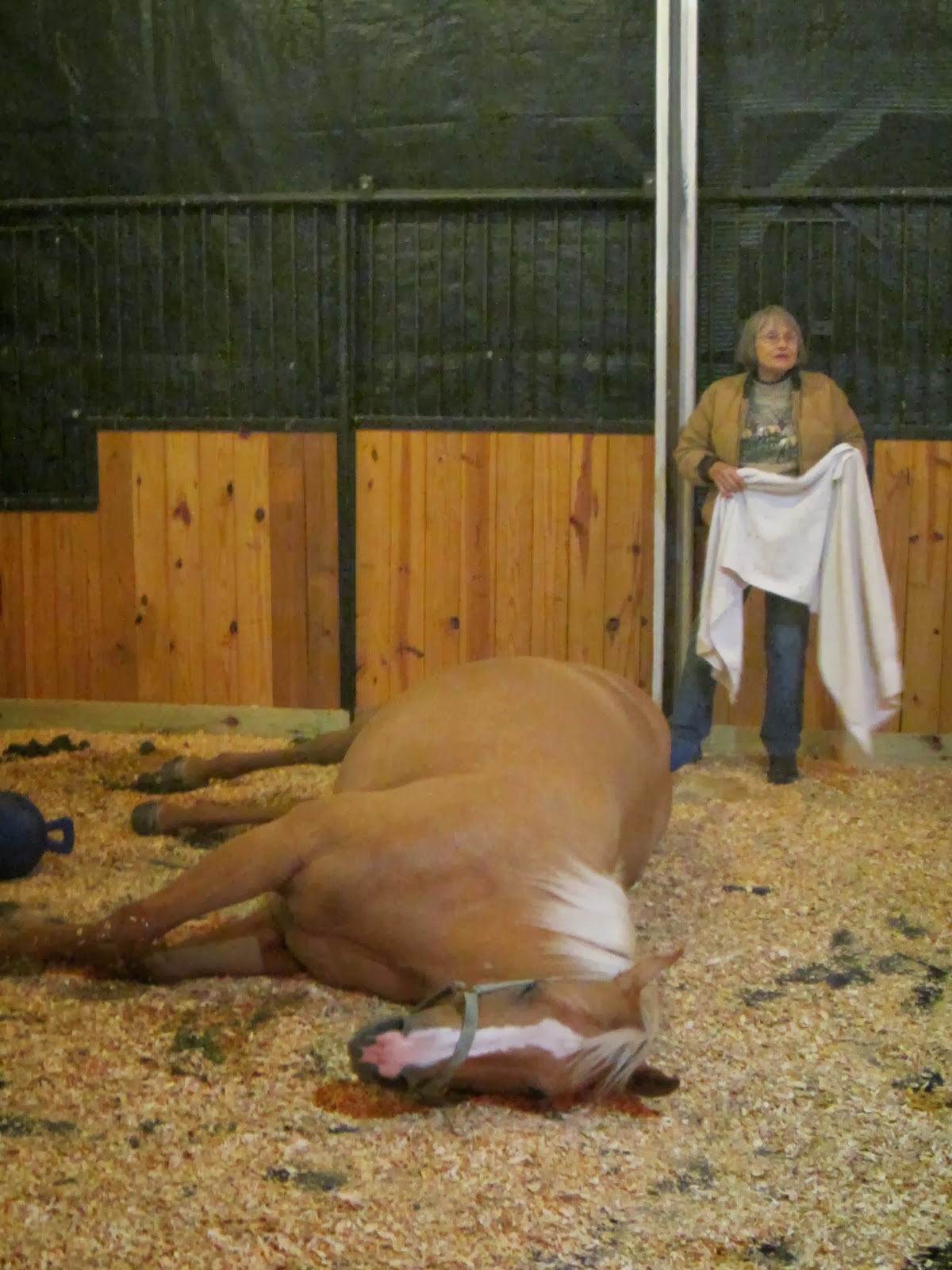
This year, we had a most exciting educational experience along with our family visitations. A baby horse was born, and we got to see it.

Not only did we get to see it from start to finish, but we endured the grueling build-up to the baby's birth, camping out in a one-bedroom apartment in the barn for four cold nights, testing the mare's milk to see if we could predict when it was due, waking up throughout the night to see if she was getting restless, and feeling a great sense of relief and elation when she started to pass amniotic fluid and to get really aggressive.

Time to Test the Milk

Hooray, the baby is coming!

The two front hooves first appeared from the birth canal at about 10 o'clock at night. The kids had started getting ready for bed, but with their two cousins joining us in our cramped accommodations for the night, they were all still a bit too wound up to sleep.

A Kind of Camping

"Hurry, Kids! Grab your coats and come see -- the feet are sticking out!"

"Stop watching TV and come see this baby!"

Not too long after this, the mare lay down on the hay-strewn stable floor, and started grunting and rocking. The water sack bulged, the nose emerged, and Grandma got down on her knees and started pulling on those little hooves, helping the baby's fat shoulders past the usual sticking point of any equine birth.

Plop! The whitest little face, one brown eye and one blue, and we were all introduced to Sparky at about 11 pm. Everyone got to pet him, especially Grandma who started her "horse whisperer" imprinting routine.

Sparky meets his Mommy


I grew up on a horse ranch in Texas throughout my teen years and saw several foals born, so I was thrilled to pieces when my children were able to experience this as well. Not just the birth, but the long. slow wait beforehand, and the training in handling, gentleness, and trust that began in the weeks afterward.


First Moments of Training
("Now where does that milk come from?")


Studying nature first-hand is just so awesome!

Thursday, 28 November 2013

Celebrating Foreign Family Holidays

It's that time of year again -- fourth Thursday in November when all of England carries about its usual weekday business, and we US-born expats try to salvage a bit of home by celebrating Thanksgiving as best we can.

This year, for the first time I think ever, we celebrated what's essentially the US version of Harvest with another American family.

A Feast for a Large Crew
It was such a blessing to bring our family's traditions and recipes together: turkey, ham, sweet potato casserole, broccoli-rice-cheese casserole, cranberry jelly and cranberry relish and cranberry jell-o, stuffing, gravy, rolls, and such an abundance that we didn't even get to the pumpkin or apple pies nor the pumpkin cake.

An amazing feat for my host and hostess considering they only moved into this house on Monday, and had to learn how to cook with an AGA oven, having never used one before.

This could be a Norman Rockwell picture!

Of course, we remember our families back in the States, the football games that are televised hours and hours later, the little things that are missing from the table like green and black olives, queso, my aunt's special fruit salad, and my cousin's wonderful buttermilk pie.

But the joy of sharing with others is that new experiences and traditions can join with the old, and we can appreciate how God has made so much variety in this world, and yet loves each one of us as an individual.

And for that, how can we but give thanks?

Monday, 14 October 2013

Meet My Kids

I had a glance at my blog today, trying to see what it would say about myself to a friend whom I've not seen since at least high school.

My first thought was that, though it showed I was busy, homeschooling, and seriously "into" my projects, it also seemed to wrongly suggest that I had only two boys.

So, here's a recent photo of my family: girl, boy, girl, boy, and hubby, and myself.

Cheers!

Top of Helvellyn, September 2013
I'm saying "ow, ow, ow" because I'd set the camera timer for 10 seconds, tripped over a rock, ripped my thumb, & tried to smile for the photo.  L to Right: Hubby, Busy Timmy, Phoenix, Rocky (with a sweet in her mouth), Killer, & myself.

Monday, 8 July 2013

Phoenix does it Again -- New Kindle Titles

Phoenix, who publishes under the pen name Ellie Firestone, has published a new book on Amazon Kindle, called The Misadventure of Bolingbroke Manor.

A New Interactive Mystery for Kindle

It's an interactive mystery, which means the reader can choose what happens next by clicking a link in the book, and then finding out what consequences that decision creates.

Interactive books are nothing new, but sometimes, a bit fiddly to "turn to page 73".  This Kindle version instantly moves to the next scene of the book with only one click of the link.

Not clear?  Let me illustrate by showing you the first page of the story (you'll have to click on the image of the text to make it big enough to read ... at least, I would have to!):


As usual, Phoenix sells her book at pocket money prices, wanting to make Kindle books for kids an accessible opportunity both in terms of price and in terms of content.  

New titles are coming soon -- more interactive stories, as well as another volume in the Super Sporty series, and Spanish translations of the two shorter stories she has already published, Super Emmy: Introducing Splodge, and Super Sporty: Signed, Anonymous.

Why not check out her author's blog and sign up to receive notices in your inbox?


Camping When It's Term Time (School on the Move)

One of the advantages of homeschooling is the ability to go on holiday when the prices are lower, the venues are less crowded, and the field trips can be clustered if they're far from home.

Recently, we took a camping trip in June for just that reason.


A tranquil little tent by the pond.

June? you might say.  Yes, in England, June is still smack in the middle of term time.  Even the private schools, which break up much earlier than the state sector, are limping toward the end of their term in June, not finishing till the first week of July.  Only A-level students, finished with exams, and some university students, are free for the summer by then; everyone else has to wait till July.

We decided on our campground based on an eclectic range of criteria: within 2 hours' drive, affordable price, allows campfires, working farm, fishing, and proper toilets/showers that aren't coin-operated. We chose Lower Hill Farm near Much Wenlock in Shropshire. Although this is a very handy place for the wonderful collection of Victorian-era museums in Ironbridge, we had already been there a few years before, so we opted instead for some English Heritage sites: Much Wenlock Priory and Wroxeter Roman City.

Our campsite, being on the footpath along Wenlock Edge, was close enough to the village to take a lovely forest stroll there and back.

Kids walk faster on their way back to camp!

The priory at Much Wenlock is near the town centre.  It's a tranquil little patch of a ruined priory, interesting to me for two reasons: first, it's about the only Cluniac church I've every seen (most are Cistercian or Benedictine, I think), and is, I think, the only one in England to have a lavabo, which is a big outdoor washing station for about 16 monks to use before going in to dine.

It wouldn't be a set of ruins that I'd take a special trip to see.  Not so much remains of it, and even the lavabo looks like a giant wheel-cog stuck in the middle of a little grassy square, having lost most of its carvings and its octagonal roofed structure in days gone by. It is, however, pleasant for a picnic, and fits into the wider study we've taken about medieval churches -- tiles like Winchester cathedral, a chapter house with some Viking-style carvings, a clear distinction between dressed stone versus the softer, more distressed stone underneath (now weathered and forlorn), and the knowledge that a woman saint was once buried near the eastern columns (now only circles in the grass), attracting pilgrims in much the same way as St Albans, St Birinus, St Thomas Becket, and the many other saints we've seen over the year.


Some walls still standing at Much Wenlock

The next day, Wroxeter required a car trip, along the smallest, narrowest, most challenging roads I think I've had the unlucky privilege to meet! Yet, it was worth it.  They have a number of interesting ruins to mooch around on one side of the road, and a recreated Roman villa on the other.  The villa seems to be a new project, with only some of the rooms furnished, but I was glad to be able to see it as a replica, helping me understand Roman life even better.


Recreated Roman Villa at Wroxeter

The great advantage of English Heritage sites is that, as home educators, we are able to apply in advance for free entry to the sites as an educational group. We don't even have to be members.

Back at the campsite, we had another educational experience when we learned to fish the English way.  First of all, the easiest and cheapest equipment were poles called "whips", which are basically telescopic poles with a bit of line on the end, a bobber, and a small, barbless hook.  Bait?  Just kernels of sweetcorn or even plain white bread.  No rod and reels, no lures, no worms -- nothing I grew up doing in Texas.  Also, no keeping the fish either.  In England, angling is strictly a sport, and though there are a few places which will let you keep the fish for eating, they will be few and far between, and are closely regulated.

Rocky and Killer use a net to get the carp
Another lesson was that of perseverance.  Poor Phoenix.  She sat and sat and sat, baited and re-baited, tossed out her line again and again and again, and in the end ...

Phoenix with her hard-earned catch
... caught the biggest carp of the day!


The nights of an English summer are very long in coming.  The fishing pictures above were both taken after dinner, probably about 9 pm.  It was about then that I lit the evening campfire, we sat around the flames, and told ghost stories (but not too scary, or the kids would have nightmares, and I'd have to cram too many people in my sleeping bag!).  

Family focus around the fire

We also continued our tradition of using wooden skewers to paint interesting patterns in the night sky -- a bit like sparklers without the spark.  We are very fond of this method, and highly recommend it to Americans whose children are afraid of sparklers on the 4th of July.  This is perfectly safe, and provides a lot more fun for the money.

Busy Timmy makes a halo with his skewer

Staying at a working farm had some great advantages, including being able to buy fresh sausages, and pork-and-apple hamburgers right out of the farmers' back door.  On my night to cook, I bought 15 burgers for our little homeschooling party of 10.  Two vegetarians, and yet, all burgers eaten!  Wow!

Rachel the Roaster BBQs some "dogs"

Finally, we came to packing up on the Thursday after three wonderful nights.  Having had no rain, all the equipment was dry (rare in England), and even though we'd eaten most of the food I'd brought, we were still struggling to find places for everything to fit in the van.  The biggest triumph was my being able to fold up the pop-up tents successfully -- having watched the instructional videos many-a-time, I felt proud to have been able to do it for real.

One 4-man tent, twisted and folded to the size of a bike tire


Thursday, 23 May 2013

A Homeschoolers' Kind of Field Trip

In April (2013), our history co-op arranged a workshop with a local National Trust property called Upton House. The remit was to discuss a number of their medieval paintings, learning to de-code their symbolism, and also appreciate what was medieval about them.

Upton House
A National Trust property near Banbury

Upton House is a great place to do this kind of in-depth study of art because:

  • it offers its educational workshops when the house is closed, so we can have the place to ourselves;
  • its education department is very good with young people, and handles any behavioural issues like Asperger's very well.
  • its works of art are deliberately displayed without glass in their frames, at eye height, and without ropes to prevent getting close, so that people can best appreciate them;
  • its art collection is extensive and of high quality, including works by painters like El Greco, Hieronymous Bosch, Tintoretto, and others (later painters include Hogarth, Canaletto, and Gainsborough).

For 1 1/2 hours, the co-op students were face-to-face with some of the works of the greatest painters in the Middle Ages, studying symbolism of flowers, of characterization, of colour, of fable, myth, and legend.

The Co-op examines Hieronymous Bosch (1450-1516),
"Adoration of the Magi"
One of them said, "Oh, how much like Dali it is!"


After the workshop, we adjourned to the lovely gardens on a beautiful spring morning. We had our picnic lunches and let the children play in the woods and by the ponds, on the stairs and amongst the flowers, waiting for the house to open to the public so that we could wander around the house and view some more of its vast art collection.

Picnic in the Park

We also were keen to get back into the house to see what changes had been made since we'd last come here three years previous, when we had visited as part of a study of the 1930s. The excellent Education Department had, at that time, assigned each of the children a role in the household staff and proceeded to explain all their duties during a typical weekend of that era. The Education Officer played the role of Lady Bearsted (of Shell Oil fame), and even my volatile 8-year-old (elevated to the stately role as butler) was the picture of duty, submission, and importance.


Last Time at Upton House
"You just can't get the staff!"


And yet, in true homeschoolers' fashion, we ditched the planned return to the interior of the house and left the children to the roaming, the exploring, the delighting in the senses, soaking up the sun and bathing their feet in the cool water of the "Mirror Lake". One of the few days so far this year with some warmth (we all got sunburned), and we decided to let the children just BE.


Exploring the Gardens

Enjoying the Sun and Friends at Mirror Lake

So, we never did get "back to business", yet it was one of my favourite field trips we've ever taken.

Friday, 1 February 2013

Oh My Gosh -- Is that Baldrick????


Is that ...? Is that ...?
It IS!!! Baldrick from Black Adder
(not that my mommy ever lets me watch that show!)
Through the Oxfordshire Home-Ed grapevine, we heard that the actor, Tony Robinson, was going to be giving a talk to primary-aged students in Oxford, sponsored by Blackwells, the local publisher and book shop.

Perhaps you know Tony Robinson as Blackadder's sidekick, Baldrick, or more recently, as the front-man for the documentary series about archeology, Time Team.

Tony Robinson explaining why we started a half-hour late:
it was a broken train!
Robinson has recently embarked on writing a series of Horrible-Histories-style books about the empires of Egypt, Greece, Rome, and Great Britain, and is soon to release two books about the World Wars.

Although we have read the one about the Romans before and thought it was so-so (the highest marks went to the translation of "There's a banana in my ear" into Latin), we didn't want to miss a chance to hear an author talk about his work.

He was high-energy, interactive, entertaining. He finished off with a quick story about empires and their desire for gold, having the audience shout out "gold" whenever he held up the prompt on a placard.

It wasn't, however, like talks we've seen before at World Book Day such as those given by Chris Bradford (Young Samurai series) or Andy Cope (Spy Dog/Spy Pup) with their slide shows and demonstrations (Bradford showed us some ninja skills, and Cope brought his dog, who was the basis of the Spy Dog books).

Book Signing
Perhaps that was because Robinson was late, his train having been stuck behind a broken one, and couldn't set up anything all-singing and all-dancing.  Still, for about half-an-hour, the 100-plus kids were spell-bound and focused, and then there was the 15 minutes or so of obligatory book signing.

All in all, a good afternoon out, even if the event itself was rather short-lived. I suppose if the weather had been tipping with rain, I might think differently -- the sunshine meant we had a lovely walk in the ancient city of Oxford regardless.

Monday, 12 December 2011

A Boyschooler's Birthday

Surprised "Killer" this weekend with a "rock school" birthday party, led by his guitar teacher and the teacher's drummer from his band, Million Faces.

Here's the song they composed during that morning's session.  It's called "Chicken Pox", and the singer is doing "pox, pox, pox," sounds along with crowing.


What a hoot!

Thursday, 8 December 2011

Trip to Ashmolean's new Egyptian Gallery

I must have been mad -- taking six children to Oxford's Ashmolean museum to look at their new Egyptian gallery.


Even madder to meet up with a friend who brought along four boys.

Two adults with ten children was ... just about do-able.


Oxford's Ashmolean Museum
est. 1683
(the current building is from 1845)

The Ashmolean likes to provide little worksheet "trails" to its young visitors, and while it's true that the children love to do them (and get rewarded with certificates afterwards for completing them), the practical side of rounding up ten children who want to dash through an exhibition just to tick boxes isn't, it would seem, completely thought out.

Ten items were identified and "collected" on their sheets, but did they read any captions?  Did they know what they were?  Like heck!

The shrine of King Taharqa --
 the only free-standing pharaonic structure in Britain
Anyway, my friend and I did our best to take them all through a second time and point out cool things -- like cartouches and the free-standing, stone pharaonic shrine of King Taharqa and real, live canopic jars like those they had fashioned out of spice jars and clay a few weeks ago at our history co-op.  I did enjoy hearing the children shout, "Hey, look, it's Duamutef."

Phoenix was fascinated by a series of glass plates, each with part of a drawing that, together, made up the CT image of a child's mummy believed to have been from 100 AD. We all wonder, however, that the radiologists hypothesized that the child had died of pneumonia when his lungs would have been removed (and put in the Hapi canopic jar).
The Ashmolean Mummy Boy 3
by Angela Palmer
Ink Drawing on 111 sheets of Mirogard Glass

Our final attempt to get extra mileage out of the trip was looking around some of the Grecian items, since we're turning our attention to Ancient Greece in the new year.  Instead, they discovered the room with pre-historic British artefacts and an interactive bow and arrow where you try to shoot some plastic cut-out stags.

Later, when I was cuddling Busy Timmy in bed and asking him what was the best part of the museum trip today, he said, "The revolving door where you go in."


Monday, 5 December 2011

What is Education For?

Recently discovered the RSA Animate stable of fascinating videos: talks with white-board cartoon drawings that illustrate a 10-minute precis of lectures ranging from education to capitalism and other economic issues.

Here is one of my favourite by Sir Ken Robinson called "Changing Education Paradigms":

And here's me with my children + friends, changing some education paradigms of our own:

Boo to "Batching!"
Children from 6 to 11 prepare to board
an imaginary LCV for re-enacting the D-Day landings.

Thursday, 3 November 2011

NaNoWriMo Takes Over

"I may be some time"

Legend has it that these were the last words of Captain Scott during his ill-fated Antarctic expedition.  Right now, they're going to be mine, as I embark on National Novel Writing Month.

In order to produce a 50,000-word novel in 30 days, I think I will have to put my nose to the writing grindstone.

In the meantime, have a look at the NaNoWriMo site for its free writing workbooks for kids.

See you in December.

In the meantime, I'll leave you with a snapshot from our trip to Stonehenge yesterday.