Showing posts with label starting out homeschooling. Show all posts

Sunday, 25 September 2016

The Three Pathways of Homeschooling

This is going to be a long post. I apologise in advance, but I encourage you to read it, and read to the end: it could fundamentally change how you educate your children at home.

You see, every August/September, I have a crisis of direction.
  • Even after doing this for 13 years.
  • Even after becoming a firm believer in the philosophy and fruits of the Charlotte Mason method. 
  • Even after applying all the good parts of public school that I learned as a teacher there, and knowing what to discard and what to bar completely from entering through our doors.

You’ve probably felt this way, too. In August and September, everyone starts shouting what they’re planning to do for the year — singing the praises of this curriculum, or that program, or about exams or credits or dual-enrollment or American style or whatever, and you think:

… maybe … I’m … doing … it … wrong.


Chances are, you are doing it wrong. Almost all of us are. Me included.

Let me explain.

First of all, I think there are basically three pathways to education, particularly home education. You can see from the introduction that I have certain biases, but we’ll probably all agree on the general principles I’m going to run through.

Number One Pathway: the school-at-home way

I call this the “world’s pathway” — that is, following the way that most people’s countries go about this whole education thing, and the fall-back position for most homeschoolers. It’s what we know, right? The bottom line of this pathway is that students are drilled in an effort to achieve pieces of paper. In some cases, they’re not even drilled: they just end up with pieces of paper because they’ve signed up for something and then proceed to teach themselves. Let me explain:

My teen has just signed up for her first “dual-enrollment” course at a local college. It’s an online English class, and it consists of reading some chapters of a book, writing a paper, and emailing it to the teacher. The teacher them writes back “accepted” or “not accepted”. If you’ve ever read T H White’s Once and Future King, this might remind you a lot of the ant colony where things are either “done” or “not done”. This seems the pinnacle of factory education to me, where a teacher runs a course only in name. All the real learning has either been done by the student before, or the student doesn’t get any real learning or … surprise, surprise … Mom does it! However she gets there, her ultimately outcome is simply this: Done.

The problem with the world’s pathway is that the outcome of “done” is what’s important, not the process along the way. Children can cram and vomit out the expected answers, then go on their merry way, none the wiser.

This is true of so many homeschool approaches, too. Don’t kid yourself: if it’s short answer, fill in the blank, multiple choice, the level of learning is minimal, and the aim, at the bottom of it all, is to be “done” or “not done”.

Number Two Pathway: focus on the process of learning

Now we come to those home educators who have opted for the second pathway, that is, learning for learning’s sake. There is no sense of “done” and “not done”, but of “doing”. They have eschewed the hoops and hurdles of someone else’s idea of success, and focus instead on the process of learning. There are different ways of achieving this aim, and some are very rigid while others are very loose; however, they don’t settle for “done” and “not done”, but are pushing the learning outcome to something lasting. This would be more your Classical Conversations, your Charlotte Masons, your Montessoris and other “living” approaches, including (to some extent) your unschoolers. Curricula and texts and activities work on the nurturing of the learner.

Clearly, as a Charlotte Mason advocate, I find this approach preferable to the first. I’ve been in the done/not done environment as a teacher, and I can spot a done/not done curriculum from a mile away, even if it’s dressed up as something else. The second pathway is clearly a higher level of learning for the student. It takes students further, deeper, broader; expands their level of brain development, motivation, retention; and turns them from “done/to done” or input/output machines into organic, holistic creatures made unique and, theoretically, more adaptable to what life throws at them.

I’m constantly trying to encourage newbies to leave the first pathway and branch out to the second one, because the first one usually leaves them feeling burned out or insufficient teachers, leads them to lots of shouting fights with their kids who find it boring and uninspiring, and therefore, prevents the warm, fuzzy feelings one was expecting to have when teaching one’s children at home. 

Almost everyone who has changed from pathway one to pathway two, if they were having problems, is happier after the change, because it suits their vision of what homeschooling would be like when they were thinking about doing it once upon a time.

PATHWAY ONE IS A LIGHT SWITCH


PATHWAY TWO IS LIKE AN AMOEBA


(Pardon my analogies … I’m doing my best!)

However - and grab onto your seats - BOTH PATHWAYS ARE WRONG!


The right pathway is pathway three. If you’re religious, it’s God’s pathway, but even if you aren’t, don’t give up … I’m not going to cram the gospel down your throat. I’m going to tell you something amazing about how to educate your children at home.

Or, maybe I should say “WHY” you educate your children at home.

You see, your educational philosophy — whether religious or secular — has a spiritual or philosophical or at least a moral element to it. I mean, if you’re trying to sit down and read a book with your kids or make them read a book, but they’re fighting instead, and you just say something like, “For goodness’ sake, can’t you just get along like good people do?!!!”

What about, “It’s not nice to hit.”

“Don’t call people names — it’s not nice.”

“Only bullies act like that.”

“Share.”

You see, the fundamental things that homeschoolers do — all of us — is instill our absolute values in our children.

Does that make you shudder? Maybe it should. You know, a Neo-Nazi white supremist family who homeschools will be inculcating their Neo-Nazi white supremist values to their kids. A free-love naturist hippy who homeschools will be passing on their free-love naturist hippy values.

Maybe they’re Muslim extremists, Christian extremists, atheist extremists, socialists, drug-heads, welfare “spongers”, Asian Tiger Moms, or even Republicans, Democrats, Greens, Libertarians, monarchists, anarchists …

Hopefully, you’ve got the point.

Just to be clear. I am absolutely not making the point that the government should “do something” about all these different isms and ists who are homeschooling their children. For one thing, no government could possibly succeed in preventing parents from passing on their values short of removing the children from the family. Even sending children to school for 6 hours a day, 5 days a week isn’t going to stop the family values from creeping into a child’s moral fabric. 

Perhaps naysayers would argue, “Well, at least they’re getting an alternative view to their parents’ weird ideas!” No, they’re getting a whole new set of ideas, few of which are helpful or preferable. More on this in a minute.

Schools, because of the plurality of the student body, can’t espouse any unifying message of morality beyond the most diluted “be good” (ie, shut up and be quiet and don’t make any waves). Clearly, it can’t put forth any religious position of absolute truths out there, or there would be major ructions. It can’t be wholly secular, either, because there are no agreed guiding principles if you have no agreement on “absolute truth”.

All the schools can do is hope that their “be nice” message and “work hard” hopes will filter down to some sort of general order, but we all know how well that’s succeeded. Even if you personally haven’t been struck down by major tragedies like mass shootings, you or someone you know will have been badly hurt by bullying — this might not be a national tragedy, but it’s darn well a personal tragedy for millions of children, all of whom relied on the school to teach a value system.

No. Schools aren’t where the value systems of worth are found.

So, legislate as they might, governments will never replace the moral compass of a child’s home. That means the only place that your child can set his or her moral compass is at your hearth, and that means the chief end of homeschooling — whatever your religious or philosophical beliefs — is a moral one.

If you’re a Christian, this is a clear-cut direction. You use the Bible to study more of who God is, who you are in God, and how that impacts on your unique mission in life. According to R C Sproul in his excellent book called When You Rise Up, this will include equipping your children to teach their own children, who in turn will teach their children, etc.

It is an impactful pathway!

If you’re not religious, then you may like to use the two fundamental principles of natural law as set out by Richard Maybury in his Uncle Eric series of books:
  1. Do all that you say you’ll do
  2. Do not encorach on others or on their property
These two fundamental principles will get you a long way amongst fellow humans in the world.*

So let me re-cap:

PATHWAY ONE - Homeschool in a way that follows input/output methodologies, where study is a means to an end like credit hours, exam grades, degrees, and a good job. This way serves a purpose.
PATHWAY TWO - Homeschool in a way that seeks learning for the sake of learning. Qualifications may happen along the way, but you’re mainly trying to equip your children for skills they’ll need throughout their lives, come what may. You focus on process more than you focus on outcome. This pathway also serves a purpose.
PATHWAY THREE - Homeschool in a way that’s mindful of the moral messages that you teach your children, both by study and by your life in words and deeds. You set the bar of what success actually means, both in terms of academic and personal success. You know a child can always learn from a book, even after having left home, but the moral compass is set when they’re young and at home. Your studies, therefore, are not taken in a vacuum. Even something like Texas History can discuss the moral issues regarding clashes of cultures and needs/wants, and these discussions can help them tease out the hard choices when they’re adults. This pathway not only serves a purpose, but serves a society.

So, if you don’t take PATHWAY THREE, does that make you a bad homeschooler?

I think it’s the wrong question to ask. You signed up to pathway three the moment you started having children, so it’s not a matter of “if” but of “when” you start walking this way.


Parenting is about journeying with your children.
Setting your child’s moral compass is a fundamental purpose of being a parent, and therefore, you should look into using every and all resources for fulfilling that purpose. Of course, moral compasses will differ from family to family. That’s the problem of our having free will because we’re human beings. I mean, clearly it isn’t for us to decide whose free will is allowed to be free, and whose isn’t.** 

Just by focusing on principles, you’ll be teaching your children that there are such things as absolutes, and that’s a eye-opening lesson in today’s relativistic world.

Having a generation of homeschoolers who know that there’s such a thing as right and wrong will be a great influence on future society, and possibly position them to be world changers.

Be careful: you’re not nurturing them so that they can be world changers … instead, you’re nurturing them first and foremost to be moral/kind/godly, and then they CAN be world changers.

SO TAKE COURAGE, MOMS AND DADS — WHEN YOU THINK YOU’RE JUST STUCK AT HOME AND NOT MAKING A DIFFERENCE, YOU COULD MAKING A WORLD OF DIFFERENCE!


*Of course, religious people would urge you to think beyond the tangible and limited world that we see, and consider the spiritual world beyond — but that’s another topic to save for another day.

** It’s easy to get self-righteous and judgmental here. Remember to take the plank out of your own eye before you point out the splinter in your neighbour’s.


Sunday, 13 March 2016

The Best Job in the World


Back, back, w-a-y back in about 2001, I was researching the idea of home-educating my daughter who was then only a year old. I was a teacher, and she was going to a child-minder three days a week. Out of the blue one day, it dawned on me: why was I leaving my own child with somebody, while I went out to teach other people's children?!!


Teaching your own has intrinsic rewards.

Sometimes, we parents get into home-education because we fundamentally disagree with the education system; or because we are torn to pieces about what a certain school or even a certain collection of children are doing to our own precious one; or because we don't find traditional schooling a good fit. All of these are perfectly good reasons, but they're kind of negative ones -- we reject the norm to embrace the unusual.

But what if the unusual were the RIGHT way, and that we embrace it because it's been the best way all along?

Learning in the "field" with the whole body

This became clear to me one summer’s day, right after I’d left that paying job. It was such a luxury to just sit on a bench and observe my toddler. She was pottering around in the grass, shaking my soda bottle and watching the bubbles, and I was amazed how I wasn't feeling the usual urge to put her on the swing for five minutes, then help her down the slide for five minutes more, wobble the wiggly bridge for five, then take her back home for a nap so I could get back to my "real" job.

The very moment it dawned on me

Instead, I could just sit there. I could just be. And let my daughter just be. 


Just let her stand in the field
and ponder the world ... that's fine.
This was when my perspective completely changed. My job now was to watch her. What made her tick? What excited her? What was difficult for her, what was easy?

The moral of this tale is this: home-education is often seen as a "running away from" or "opting out" of traditional schooling, but I want to encourage everyone who's involved in it to see it with new eyes. Not running away, but leaping into, soaring through, bounding ... or, if you're a quiet and methodical sort ... ambling/walking/tip-toeing along the path that you were made to follow. 


Clearly, we don't all learn the same way!


It's a path that you travel WITH your children, not a direction you point them in!

Life and learning are journeys ... together!

And that's why, of all the jobs I've had, homeschooling my kids is the best job in the world!


(This article first appeared in the Home Ed Gazette, an email newsletter available by contacting the editor at homeedgazettegmailcom)

Monday, 17 August 2015

Drawing Contest for new Chaucer Book

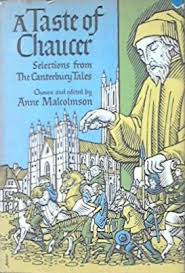
If you've ever tried to introduce your children to Chaucer, you may discover that you can find either story-book versions or modern translations. The former is rather dumbed-down, and the latter is ... well, if you know anything about Chaucer, Too Much Information!!!

To my mind, there is only one book that gives an adequate flavour of The Canterbury Tales without all the rude, farty bits, and that's a very old book called A Taste of Chaucer by Anne Malcolmson.


Now a rare book!


Up until about three years ago, A Taste of Chaucer was available in paperback from Sonlight, but after the death of the author, it disappeared from the catalogue, and pretty much all affordable options dried up.

However, good news! The book is due to make another appearance, this time in ebook format, thanks to the generosity of Malcolmson's family.

Knights dance at the news!


The publication date is set for 10th of October, 2015. Sign up to the website for updates, and "like" the Facebook page.

In the meantime, the publishers are looking for homeschoolers to draw some pictures as illustrations of the new ebook. Details are here: http://www.atasteofchaucer.blogspot.co.uk/p/the-images-we-need.html

All styles, stages, ages and abilities are encouraged to enter -- the wider variety, the better. The only real limitation is that the pictures must be original and drawn in black and white.

Enter now -- all winners get free copy of the book!


Saturday, 11 October 2014

The Interview -- Who I am , Why I home-ed, How I home-ed, etc.

I was recently interviewed on FB for a home-edder's blog about homeschooling, especially to encourage newbies. I thought it might be worth reproducing here.

Who am I? I was born in Texas, but now live near Oxfordshire. I have a PhD in literature, a PGCE in secondary education (English), and formerly taught in private girls' schools in Oxford. Now, I homeschool my four kids who range from 7 to 14, examine for Cambridge International at iGCSE and A-level, and run my own online tutorial business for homeschooled students throughout the world (called Dreaming Spires Home Learning: links below).

Blown away in the Orkneys


Why did I start homeschooling?
My interest in homeschooling started when my eldest was about 3 1/2 -- she was a late-summer baby, and Oxfordshire changed its entry policy to start children in the YEAR they turned 5 instead of the TERM they turned 5, so she was due to start when she had just turned 4. Being American, where children start in the September AFTER they turn 6, I found this unacceptable. I was even more spurred on by three things: the book called Better Late than Early by Raymond S Moore which argues that children aren't ready for school in a variety of aspects from eyesight to emotional maturity; the fact that our local school was being very anti-Christian at the time, and I have a strong desire to promote a trust and respect for God in our day-to-day lives, plus my daughter was a very intense child and often bullied even at the sweet Montessori nursery where she went -- my belief was this personality was given to her by God, and I didn't want an institution to bully her out of her natural personality; and finally, from the practical viewpoint, I didn't see the point of my being paid to teach other people's children, and paying for my own to be taught by someone else -- I could just cut out the middleman!

What top tip would I give newbies? 

  • If your children are under 6, take a leaf out of Life Child in the Woods or other natural childhood books -- they really, really, really need to have a lot of physical activity to develop their inner ear, and if this doesn't get developed when a child is young, it will never fully develop. Same with things like literacy and numeracy and spatial skills -- there is a time in the brain when these will develop, and it's rarely before 6. Eyesight, too, isn't developed enough for reading a lot till after 8. Three of my kids now wear glasses, and I wish I'd not rushed things when they were younger. 
  • If your children are between 6 and 12, I'd say that taking things slowly at first, establishing a nice routine for living and learning in the mornings (a la Charlotte Mason, which is the method I like), and make sure, above all, that you finish "table work" academics by lunchtime, freeing a child to explore the parts of life and hobbies that inspire them. They need to be left alone to be bored; otherwise, they will never learn to motivate themselves. They also need to be left alone to learn that things don't work in life like a microwave does -- planting a garden or building a tree house or whatever, these things take time, and include a lot of trial and error. 
  • Finally, if your children are older than 12 and you're in the UK particularly, please don't rush into taking exams. The British exam system is so limiting and narrow, and the point of education is to be inspired, broad, and connected, not to mention, children need to know how to learn for themselves.

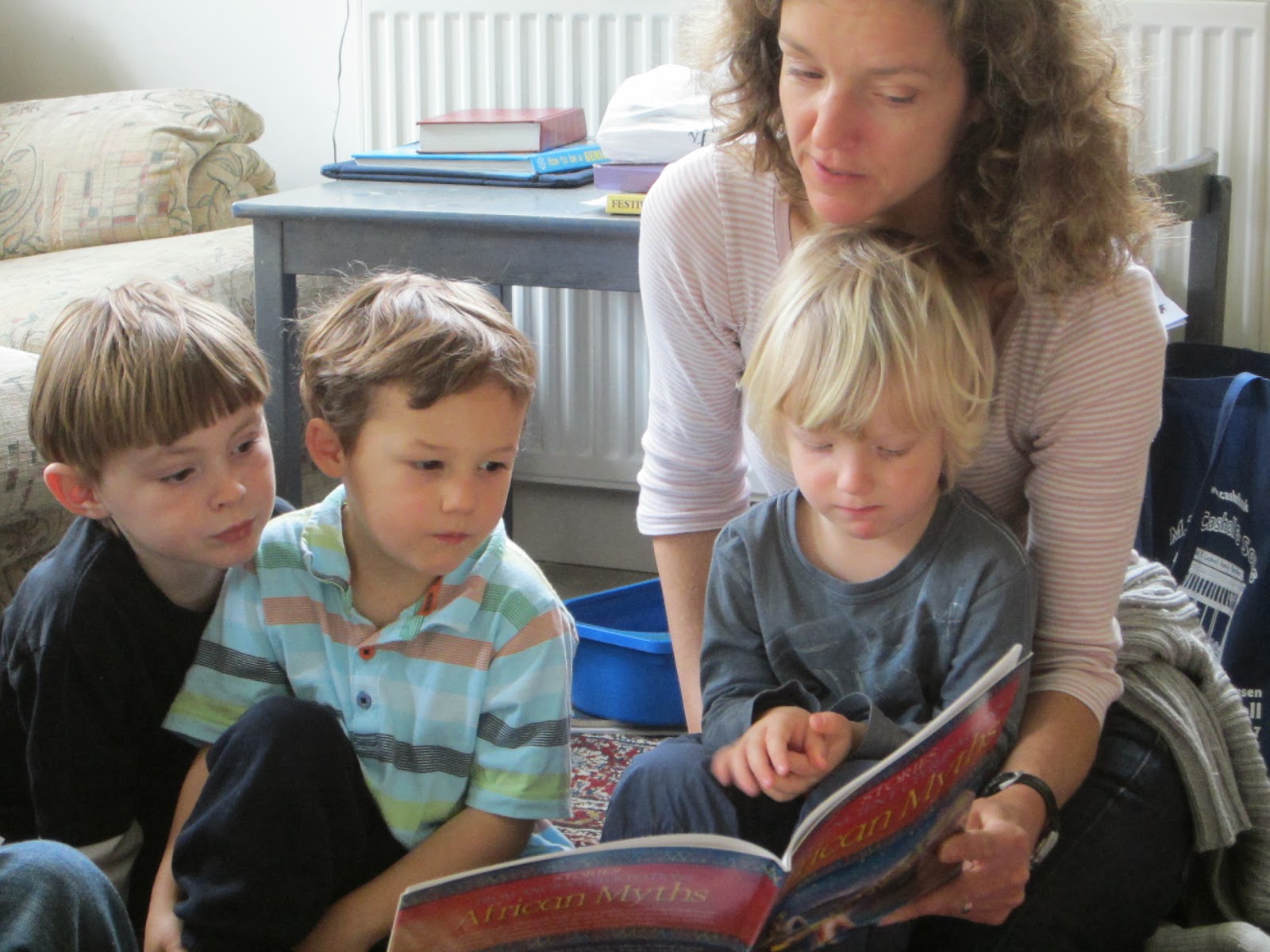
Is there such thing as a typical day? Our routine is to do chores in the morning before 10, then sit in our school room until about 1 pm. This happens three days a week, as one day, my youngest has private swimming lessons so my older ones work on their homework for the online literature and/or art appreciation courses they do, and another day, we meet with a family for watching videos about the Bible or biblical issues, and we're studying art this year together. On our other three days, we start with Bible, then read a selection of books about chemistry, biography, history, natural history, geography, and literature. While I read, they usually paint or draw or play Lego, then they narrate back to me what was read so they can solidify the story and what they learned from it. 

My school room


My students
Once the reading is done, the children separate to work on their maths and copywork. If I can snatch some time in the afternoon, I might sit down with someone and read a book to them that only they want to hear. My 9-year-old, for example, really enjoys the book about the Titanic called A Night to Remember. My 7-year-old likes A Pocketful of Goobers, about George Washington Carver and the invention of peanut butter. My 14-year-old enjoys all things Brother Andrew who founded Open Doors, and my 11-year-old follows me around the house to read his weekly assignments from the online literature class: it's tough reading, like Spenser's Faerie Queene, so I totally understand, and really admire this year that he's decided he wants to get an A in the course, even though it's a course designed more for 14-year-olds.

What's the best and worst thing about HE? There are so many positive things about HE, but the best to me is relationships -- we really get to know each other, we have to learn to get along, we have to realise that our actions have a knock-on effect on the family (whether it's something like breaking a dish or failing to do one's chores), we can't just swap our siblings and parents but have to sort out difficulties, we have to take turns and share and work out what's the difference between equal and identical. This doesn’t mean my kids have no friends: far from it. We could have an outing every day or visits morning and afternoon if we wanted to, but my kids are competitive swimmers and mostly out every evening, so we try to stay home for those three days of study, and preferably, without distractions. Other positive things are taking holidays when prices are lower, traveling to see family in America for a month or more at a time, leaving the books behind if the weather is particularly gorgeous, taking the time to eat healthy, un-rushed lunches.

To sum up -- TIME!


Texas Baseball in June - holiday freedom

 The worst thing? Honestly, I can't find a down-side. Sure, there are issues one must face like a messy house or higher food/electricity bills or setting aside time for appointments like hair cuts or even just prayer time, but it's only a season of life, and these things can be worked around, planned for, accepted. I remember when my eldest turned 9 and I realised I'd had her for half the time that she would probably be living at home -- I had seen her every day of those 9 years, and I still thought: "Oh, my gosh! We're halfway through already!!!" (BTW, my daughter said, "Oh, no!!!! I have to live my life all over again before I can drive!!" It's all about perspective, isn't it!!!!) So for all the annoying little bits here and there, I will know that I gave it my all, and spent as much time with my precious kids as I could while I still had them at home.  It goes sooooo fast in the grand scheme of things.

Something to link to, or promote?


Boyschooling is my personal blog about my family's homeschooling journey, and especially about homeschooling boys. I also have a blog for the online tutorials I run for homeschooling teens:  www.dreamingspireshomelearning.co.uk or the US-based version at www.dreamingspireshomelearning.com. My online classes are designed for homeschooled students from age 12 and up, and whether US, UK, NZ, or wherever, I try to make them relevant to your aims like exams or college entrance, but more than that, I aim to teach the kids how to have a relationship with books that will last a lifetime. 

I also offer Easter “crammer courses” for the UK national exams:  iGCSE English Language (CIE board) at www.dreamingspiresrevision.blogspot.co.uk


Friday, 15 August 2014

Now THAT'S a big timeline!

Whether you're a follower of the Charlotte Mason method or not, I think having a working timeline for your family is a very important addition to your history studies.

Children can cope with our tendency to hop around historical studies -- even schools, notorious for having children dress up like Cleopatra one day and an Evacuee from World War II the next, are able to help their pupils form some kind of mental timeline in their heads.

Yes, the Egyptian pyramids were built before Hadrian's Wall.

But did you know the Egyptian pyramids were being built the same time that Stonehenge was being built?


In the Charlotte Mason method, the usual suggestion is to keep a Book of the Centuries. This is nothing more than a loose-leaf notebook where you insert pages in chronological order, perhaps even jotting down a list of things that happened roughly in the same era.

We have tried a "BOC" in the past, but it just wasn't visual enough for me -- just not enough


 for my liking.


Other methods have their own preferences: Konos curriculum has a wall timeline where you put cut-out figures on their century; Montessori has a little number-line kind of timeline that makes one work out that 1st century means 0-99 AD. I'm sure there are scores more.

In the end, though, we took 54 pieces of A4 card, used clear packing tape to stick them together (with a gap between the card so the tape works as a hinge), and created a 30-foot timeline. At the earlier end, each piece of card is a millennia, but as we work our way past 0 AD, it tends to be centuries.

Killer holds the 30-foot long timeline

Sometimes, we fill up a century easily, such as our study of the English Civil War last year. If that happens, we just tape another piece of card over the top, hinging at the top so it lifts up like a giant flap.

We mix photocopies and drawings,
text and print-outs
(Yes, that's Phineas and Ferb in the chariot)


We're in our fourth year of using this timeline, and it serves as an excellent tool for review as well as for putting our studies into context.

Why don't you try one? It will cost less than a fiver. whatever your currency!

Saturday, 5 April 2014

Home Education is Just Life

This past week, we took a holiday in the Lake District, a week before schools let out for Easter holidays. We often do this to avoid the traffic, the crowds, and the holiday surcharges -- chalk up yet another advantage for homeschooling.

Homeschoolers in the Hills

On this trip, though, I became much more aware of how homeschooling is a whole package, that even on holiday, we are still teaching, learning, exploring, and best of all, growing as people.

Let's take Lesson Number One: how you have to persevere, even when it's hard.

Ascents can be exhausting!

This is a great lesson to learn as you climb up mountains. Yes, it's hard, and yes, it's tiring, and yes, it sometimes hurts -- but you can never quit, because there's no other way to get home! Encourage each other; make up games like how many steps you can keep going in a row, or who can suck a sweetie the longest; keep your eyes on the goal ahead (ten more minutes, or keep going till that crag up there, or the summit's just around the corner); above all, put one foot in front of the other till you succeed at your goal.

Life can be like this.  Whether it's swimming training or races, which is our sport of choice, or reading a long novel, or later on, when one is in business, at university, or trying to keep a marriage going -- JUST KEEP GOING!!! It may be hard at times, but you can do it if you don't quit.

Lesson One: Never give up!

What about Lesson Number Two: climbing mountains is a team game. We have particular difficulties with Rocky and Timmy, trying to push past each other to the summit and knocking each other to the ground. Tears, cuts, dangerous behaviour, not to mention embarrassing arguments on the hills which reverberate throughout the quiet valleys.

Winning is not always the goal.
Having recently discovered cooperative board games like Pandemic, this concept was readily accepted once we discussed it at length: there are no individual winners or losers when climbing mountains, but we ALL win when we get to the top.  Conversely, if anyone loses (ie, injured), we ALL lose, we ALL fail to reach our goal, we ALL have problems in trying to get back to the safety of the car/cottage/cafe.

Work Together to Achieve the Goal!
We even had a Lesson Number Three that was specifically about school -- what do you do if you read books but don't understand them? Rocky is particularly keen to keep up with Killer and Phoenix in their book choices, tackling titles like "Dracula" and "Divergent" on her Kindle, but not understanding what's happening in them.

This lesson was for me: "Clearly," I said to her as we trudged up the 2600-foot summit of Grisedale Pike, "I need to spend more time reading aloud to you so you can better understand these hard books."

Rocky marches to her own drum.
She's such an independent soul that she often gets cut loose on projects herself, but I need to remember that she's only 9 and still needs the same level of nurturing that my more needy kids need.

In homeschooling, no child need be left behind.
Education, like life in general, should be a team game, and sometimes, the coach needs to do a bit of coaching to ensure that we're reaching our goals.  For me, the goal is to make education an atmosphere, a discipline, a life -- these are the words of Charlotte Mason, a Victorian educator and originator of a popular homeschooling method, and the words that we live by, whether in the school room, in the living room, or in God's great outdoor room!


Friday, 14 February 2014

English Civil War Workshop in Oxford

Traipsing around Oxford in the pouring rain in the wettest
winter on record (almost), we met up with 11 other homeschoolers at the Museum of Oxford for a workshop on the English Civil War.

Flood Times in February
Our hands-on portion was led by Kate of the Education Department, and she had the children try on replica clothes and think about what it would be like if suddenly 6000 extra people were billeted in a city of 10,000.
Kate Dresses a Cavalier

This discussion session usually takes about 45 minutes (so we were told), yet you know what homeschoolers are like:

  • What do the beeswax candles smell like?
  • How tall were the pikes?
  • Did soldiers have to carry their blankets and food with them?
  • What would water taste like if you drank it out of a leather flagon?
  • Why would you even drink the water, if 6000 extra people were throwing their sewage into the Thames?


Look at all those raised hands!

So the 45-minute session turned in 1 1/2 hours, capped off by the chance to write with quill pens on parchment paper.

Getting the Knack with Quill and Ink
"Dear Mom, I gave my wife the
keys and she won't let me in
the house. Thanks."

The last part of the 2-hour workshop entailed some time in the museum collection, but unlike the previous incarnation of the museum, with lots of bits and bobs from the Civil War era, the current displays have very little to see of any era, and was very disappointing. Judging from the website, this is only temporary as the real galleries are due to open next month after refurbishment.

Killer in a Bowler

To me, the best part of these workshops are meeting other homeschoolers in the area. Today's group seemed especially wonderful, for some reason. Attentive and inquisitive, knowledgeable and keen, the kids seemed to get a lot out of it, and let others get a lot out of it, too (including the four mums and dads who stayed to join in).

A Mum Lurking for Her Turn
with the Quill Pen!


Tuesday, 4 February 2014

The New Look of Narration

Following the Charlotte Mason method as I do, we are always reviewing our reading and studies for the day by using a technique called narration.  In simple terms, this is just "telling back" what we've just read, and is undoubtedly a brilliant way of remembering information: much better than fill-in-the-blank, or short answer, or even asking kids questions and having them respond.


Narration is telling back what you've just read.

(As an aside, I recently did a test of its effectiveness by narrating some of my own reading to myself by writing down summaries, versus just carrying on without reviewing after I'd read. My memory and understanding of the material I narrated was far superior to that which I didn't narrate, and I still remember now the things I summarized, but not the things I didn't!)

Today's task was based on the Chemistry and Physics book, new from Apologia Science, in which we have been studying matter, and more recently, different properties of gold and iron pyrite such as magnetism, hardness, smell, and reactions to chemicals.

Using a graduated cylinder to observe volume.

We narrated this yesterday by discussion, but today, Killer has gone one step further and made a Pivot video. I think he won't be forgetting this science lesson in a long time!

Hope you enjoy!


Sunday, 2 February 2014

A Look at Free-Day Friday

At the beginning of the year, I made a mistake. I told my kids we wouldn't school on Friday.

Hooray! No school on Fridays!
There was method in my madness -- the year before, Fridays had been Busy Timmy's day to have private swimming lessons, and by the time we all trooped back home, it was about 11, and shortly thereafter, we would all head off to the afternoon youth group I run.

Busy Timmy gets ready to collect
children from the local school
to come to the youth club

Needless to say, that doesn't leave a lot of time for study.

No time for Life of Fred
on a Friday, I'm afraid.
It's true that, over the years, I've come to the conclusion that it's actually a good idea to carve out a day where you can a) have social calls from other home-ed people, b) invite newbies over for a chat, c) schedule workshops without disrupting the other school days, and d) catch up with chores, laundry, and housework.

So, why am I now re-thinking my announcement of a free-day Friday? Because Busy Timmy's swimming lessons got changed to Thursdays, and my lovely plans for afternoon reading with one child at a time got scuppered when I moved my Dreaming Spires classes to meet on Tuesdays and Thursdays ... our long-standing Monday afternoon play-date ... music lessons ... Wednesday afternoon youth-group leaders' meetings ... thus, afternoon school has just disappeared from our schedule entirely, which was never part of my original plan.

The temptation is to renege on my original announcement about Friday, and reinstate it as a normal school day in our home -- that is, chores before 10, then Blocks 1 to 3 until lunch. Yet, I have discovered recently that Friday is not a dead loss after all, and for two reasons:

First, we are actually covering a lot of ground in our studies during the rest of the week, even though we only sit at our school-room table on Monday, Tuesday, and Wednesday mornings. The two older ones have additional work for the Dreaming Spires classes which they do in their own time, and Thursdays is a Bible study/literature co-op with another family in a town about 14 miles away.

Do we really need to give up our Friday free-day if this is the case?

Oh, no! Say it isn't so!!!

The second reason is that Friday can actually be a really lovely time to spend some low-key one-on-one time with each child. With one of them, I'll read a book (I love reading "Money Mystery" with Phoenix). With another, we'll play a card game like Zeus on the Loose (sneaky way of strengthening maths!). Another one wants to show me his video animation, and the fourth wants to do food technology.

Rocky's taste test:
carton orange juice, or fresh-squeezed?

Meanwhile, they're each having a session of Spanish with the au pair.

Phoenix (aka Ellie Firestone on Amazon)
 gets translation help with her short stories

So Friday is not lost after all. It's just a different route to the same destiny, and that is trying to create an atmosphere of learning in our household a la Charlotte Mason. So we'll keep free-day Friday, and all will be glad!

"Awesome!"

Monday, 20 January 2014

A Satisfying Christmas Study

Most every year, we travel to Texas from England to visit my family, most of whom still live there. The cost and hassle of travel means that we like to stretch the holiday as long as possible -- sometimes as much as a month -- and this is of course only tenable because we homeschool (reason number mumbly-six for homeschooling, right?!).

Off to Grandma's House!

This year, we had a most exciting educational experience along with our family visitations. A baby horse was born, and we got to see it.

Not only did we get to see it from start to finish, but we endured the grueling build-up to the baby's birth, camping out in a one-bedroom apartment in the barn for four cold nights, testing the mare's milk to see if we could predict when it was due, waking up throughout the night to see if she was getting restless, and feeling a great sense of relief and elation when she started to pass amniotic fluid and to get really aggressive.

Time to Test the Milk

Hooray, the baby is coming!

The two front hooves first appeared from the birth canal at about 10 o'clock at night. The kids had started getting ready for bed, but with their two cousins joining us in our cramped accommodations for the night, they were all still a bit too wound up to sleep.

A Kind of Camping

"Hurry, Kids! Grab your coats and come see -- the feet are sticking out!"

"Stop watching TV and come see this baby!"

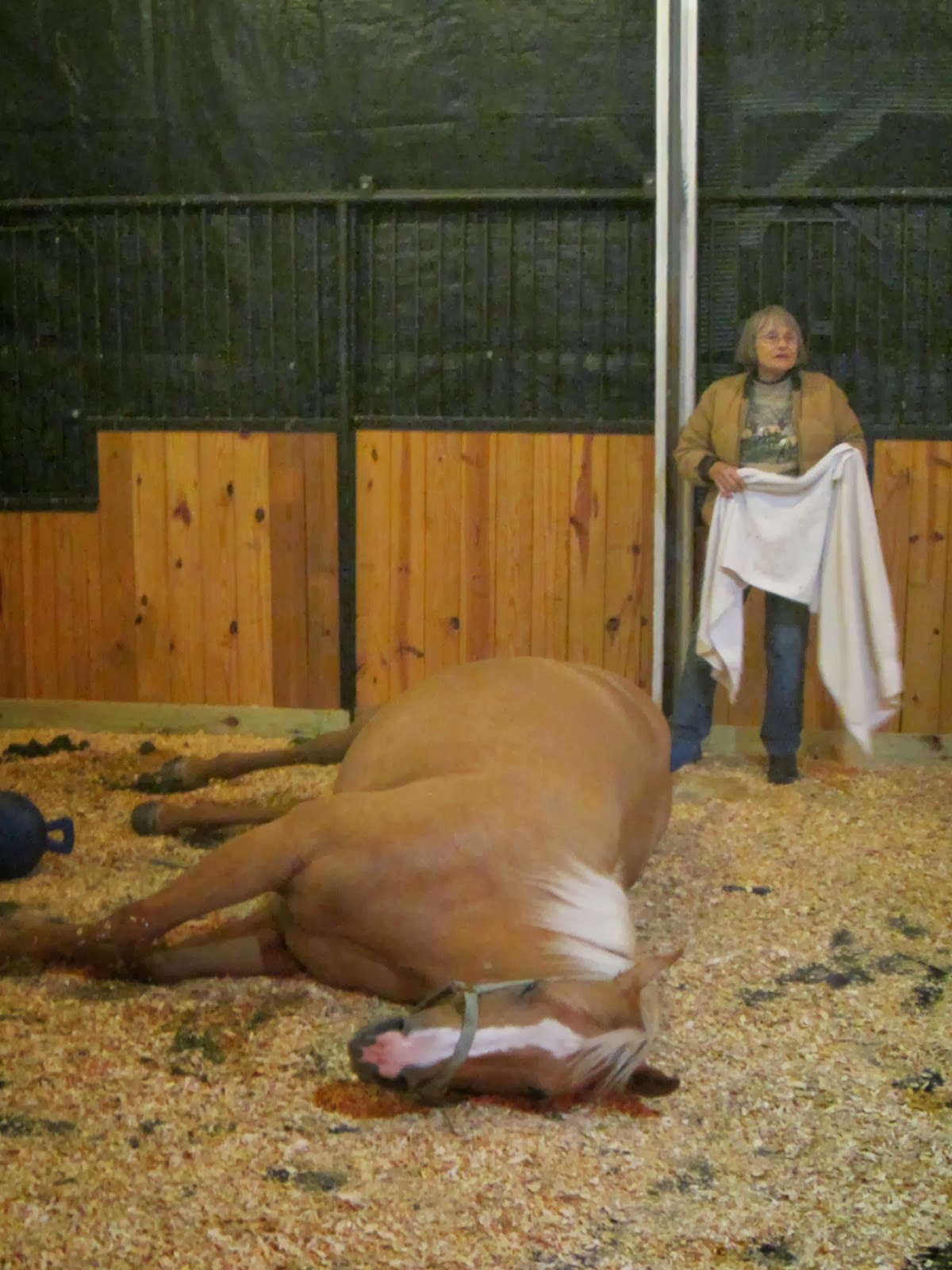
Not too long after this, the mare lay down on the hay-strewn stable floor, and started grunting and rocking. The water sack bulged, the nose emerged, and Grandma got down on her knees and started pulling on those little hooves, helping the baby's fat shoulders past the usual sticking point of any equine birth.

Plop! The whitest little face, one brown eye and one blue, and we were all introduced to Sparky at about 11 pm. Everyone got to pet him, especially Grandma who started her "horse whisperer" imprinting routine.

Sparky meets his Mommy


I grew up on a horse ranch in Texas throughout my teen years and saw several foals born, so I was thrilled to pieces when my children were able to experience this as well. Not just the birth, but the long. slow wait beforehand, and the training in handling, gentleness, and trust that began in the weeks afterward.


First Moments of Training
("Now where does that milk come from?")


Studying nature first-hand is just so awesome!