Showing posts with label behaviour. Show all posts

Friday, 3 February 2017

BLAST from the PAST -- Remembering back to those Toddler Days!

I was cleaning out the hard drive on my computer today and came across this article I wrote but never published about getting jobs done around the house while homeschooling young kids.

The memory of those days with four kids under 7 is a hazy one, but reading my advice from then feels surprisingly relevant still today, and I can see a lot of the fruit from some of those routines and diversions.

Hope you'll be blessed by this if you feel unable to release those grasping hands from your "skirts" when all you want to do is clean a toilet or fill the dishwasher.

Trust me: this season will pass!


WHISTLE WHILE YOU WORK: 5 SURE-FIRE WAYS TO KEEP THE KIDS BUSY (WITHOUT RESORTING TO THE TELLY)*

*This should now read: without resorting to electronics

As a home-schooling mum with young children, I’m often asked how I can get any jobs done with kids always around. I won’t lie and say it’s easy (I’m definitely no super-mum), but with my five sure-fire tips, you, too, can keep your house reasonably tidy, get dinner on the table, and even find time to read, sew, iron, or bake some homemade bread!

1. If they can’t beat you, let them join you.


Pre-schoolers are incurable mimics. They are also desperate to be “big”, so when they see you hoovering, they want to help. Instead of evicting them, try involving them. You will probably have to accept that a chore will take twice a long with your little helpers, but there are other benefits, including:

  • enjoying each other’s company; 
  • making them feel useful; 
  • teaching them a skill that one day they can do on their own. 
Cooking continues to be a favorite pastime 

2. Share the load.


On the subject of responsibility, don’t be afraid to assign a simple task to them. Children are a lot more skilful than we often give them credit for. Sorting socks, folding towels, emptying dishwashers, and tidying away toys are all within the abilities of quite young children. Just don’t expect perfection. My boy was a little over a year old when he started helping with the laundry by throwing dirty clothes down the stairs, but lately he has taken to throwing the clean laundry down as well!

No longer "share the load" but DO the load! 

3. Discover audio books.


Audio books are tapes or CDs where actors read stories aloud, usually with sound effects and music as well. Children as young as eighteen months find them entrancing. Ladybird Books offer a whole range of fairy tales with accompanying tapes, such as “Pinocchio”, “Three Billy Goats Gruff”, and “The Gingerbread Man”. Local libraries also stock longer stories like “The Velveteen Rabbit”, and Amazon sell read-along soundtracks to favourite Disney classics like “Monsters Inc.” or “Snow White”. Two words of caution about audio books: first, you may want to preview material, as it may be unsuitable for toddlers; and second, you may prefer CDs to cassette tapes so you don’t have to keep coming back to turn the tape over.


We've moved from audio books to voracious reading 

4. Turn on the sink.


Sometimes, you need five or ten minutes for a concentrated effort, but there’s a danger of wallpaper desecration if you dare turn your back. That’s where the sink can become your ally. Using a sturdy stepping stool, park your child in front of the basin with a toothbrush in one hand and a small beaker in the other, turn on the cold tap to its lowest trickle, and then dash to your desperate duty. It may be the case that you spend thirty seconds wiping up the puddles when you return, but on balance, you will have come out ahead.


There's still something special about water on the skin 


5. Send them to the garden.


I’ve saved my favourite tip for last. I’m a firm believer in giving children as much fresh air and active play as possible, and when they can do that while I get some work done, all the better. Of course, you won’t want to leave your young children unattended, but should your kitchen sink look out over the garden (as mine does), then you will find that you can do quite a lot of chores while keeping one eye on the kids. If it’s your lounge or bedroom window, think about doing the ironing or folding clothes.


My teen has never outgrown a snooze outdoors 


Finally, let me offer a bonus tip for those times when you need utmost concentration, such as balancing your chequebook or paying bills. Find a reliable teenager – as young as 13 would be fine – and pay them a few pounds to play with your children for an hour or so. These are sometimes called “mother’s help” -- because they aren’t actually having to shoulder responsibilities like a babysitter -- but I think they a better name for them would be “mother’s godsend”.


FIVE TERRIFIC TOYS FOR KEEPING THEM OCCUPIED


1. Indoor trampoline. It may prove so popular, you’ll need two!

2. Lego. Choose a size that’s appropriate for the age of your children.

3. Toy kitchen.Mine doubles as a shop, with a much-beloved cash till.

4. Trains.Or any set of things they can unpack, arrange, and re-pack – hopefully, over and over again!

5. Puzzles. More for nursery-aged children. For toddlers, substitute shape boxes.


Sunday, 25 September 2016

The Three Pathways of Homeschooling

This is going to be a long post. I apologise in advance, but I encourage you to read it, and read to the end: it could fundamentally change how you educate your children at home.

You see, every August/September, I have a crisis of direction.
  • Even after doing this for 13 years.
  • Even after becoming a firm believer in the philosophy and fruits of the Charlotte Mason method. 
  • Even after applying all the good parts of public school that I learned as a teacher there, and knowing what to discard and what to bar completely from entering through our doors.

You’ve probably felt this way, too. In August and September, everyone starts shouting what they’re planning to do for the year — singing the praises of this curriculum, or that program, or about exams or credits or dual-enrollment or American style or whatever, and you think:

… maybe … I’m … doing … it … wrong.


Chances are, you are doing it wrong. Almost all of us are. Me included.

Let me explain.

First of all, I think there are basically three pathways to education, particularly home education. You can see from the introduction that I have certain biases, but we’ll probably all agree on the general principles I’m going to run through.

Number One Pathway: the school-at-home way

I call this the “world’s pathway” — that is, following the way that most people’s countries go about this whole education thing, and the fall-back position for most homeschoolers. It’s what we know, right? The bottom line of this pathway is that students are drilled in an effort to achieve pieces of paper. In some cases, they’re not even drilled: they just end up with pieces of paper because they’ve signed up for something and then proceed to teach themselves. Let me explain:

My teen has just signed up for her first “dual-enrollment” course at a local college. It’s an online English class, and it consists of reading some chapters of a book, writing a paper, and emailing it to the teacher. The teacher them writes back “accepted” or “not accepted”. If you’ve ever read T H White’s Once and Future King, this might remind you a lot of the ant colony where things are either “done” or “not done”. This seems the pinnacle of factory education to me, where a teacher runs a course only in name. All the real learning has either been done by the student before, or the student doesn’t get any real learning or … surprise, surprise … Mom does it! However she gets there, her ultimately outcome is simply this: Done.

The problem with the world’s pathway is that the outcome of “done” is what’s important, not the process along the way. Children can cram and vomit out the expected answers, then go on their merry way, none the wiser.

This is true of so many homeschool approaches, too. Don’t kid yourself: if it’s short answer, fill in the blank, multiple choice, the level of learning is minimal, and the aim, at the bottom of it all, is to be “done” or “not done”.

Number Two Pathway: focus on the process of learning

Now we come to those home educators who have opted for the second pathway, that is, learning for learning’s sake. There is no sense of “done” and “not done”, but of “doing”. They have eschewed the hoops and hurdles of someone else’s idea of success, and focus instead on the process of learning. There are different ways of achieving this aim, and some are very rigid while others are very loose; however, they don’t settle for “done” and “not done”, but are pushing the learning outcome to something lasting. This would be more your Classical Conversations, your Charlotte Masons, your Montessoris and other “living” approaches, including (to some extent) your unschoolers. Curricula and texts and activities work on the nurturing of the learner.

Clearly, as a Charlotte Mason advocate, I find this approach preferable to the first. I’ve been in the done/not done environment as a teacher, and I can spot a done/not done curriculum from a mile away, even if it’s dressed up as something else. The second pathway is clearly a higher level of learning for the student. It takes students further, deeper, broader; expands their level of brain development, motivation, retention; and turns them from “done/to done” or input/output machines into organic, holistic creatures made unique and, theoretically, more adaptable to what life throws at them.

I’m constantly trying to encourage newbies to leave the first pathway and branch out to the second one, because the first one usually leaves them feeling burned out or insufficient teachers, leads them to lots of shouting fights with their kids who find it boring and uninspiring, and therefore, prevents the warm, fuzzy feelings one was expecting to have when teaching one’s children at home. 

Almost everyone who has changed from pathway one to pathway two, if they were having problems, is happier after the change, because it suits their vision of what homeschooling would be like when they were thinking about doing it once upon a time.

PATHWAY ONE IS A LIGHT SWITCH


PATHWAY TWO IS LIKE AN AMOEBA


(Pardon my analogies … I’m doing my best!)

However - and grab onto your seats - BOTH PATHWAYS ARE WRONG!


The right pathway is pathway three. If you’re religious, it’s God’s pathway, but even if you aren’t, don’t give up … I’m not going to cram the gospel down your throat. I’m going to tell you something amazing about how to educate your children at home.

Or, maybe I should say “WHY” you educate your children at home.

You see, your educational philosophy — whether religious or secular — has a spiritual or philosophical or at least a moral element to it. I mean, if you’re trying to sit down and read a book with your kids or make them read a book, but they’re fighting instead, and you just say something like, “For goodness’ sake, can’t you just get along like good people do?!!!”

What about, “It’s not nice to hit.”

“Don’t call people names — it’s not nice.”

“Only bullies act like that.”

“Share.”

You see, the fundamental things that homeschoolers do — all of us — is instill our absolute values in our children.

Does that make you shudder? Maybe it should. You know, a Neo-Nazi white supremist family who homeschools will be inculcating their Neo-Nazi white supremist values to their kids. A free-love naturist hippy who homeschools will be passing on their free-love naturist hippy values.

Maybe they’re Muslim extremists, Christian extremists, atheist extremists, socialists, drug-heads, welfare “spongers”, Asian Tiger Moms, or even Republicans, Democrats, Greens, Libertarians, monarchists, anarchists …

Hopefully, you’ve got the point.

Just to be clear. I am absolutely not making the point that the government should “do something” about all these different isms and ists who are homeschooling their children. For one thing, no government could possibly succeed in preventing parents from passing on their values short of removing the children from the family. Even sending children to school for 6 hours a day, 5 days a week isn’t going to stop the family values from creeping into a child’s moral fabric. 

Perhaps naysayers would argue, “Well, at least they’re getting an alternative view to their parents’ weird ideas!” No, they’re getting a whole new set of ideas, few of which are helpful or preferable. More on this in a minute.

Schools, because of the plurality of the student body, can’t espouse any unifying message of morality beyond the most diluted “be good” (ie, shut up and be quiet and don’t make any waves). Clearly, it can’t put forth any religious position of absolute truths out there, or there would be major ructions. It can’t be wholly secular, either, because there are no agreed guiding principles if you have no agreement on “absolute truth”.

All the schools can do is hope that their “be nice” message and “work hard” hopes will filter down to some sort of general order, but we all know how well that’s succeeded. Even if you personally haven’t been struck down by major tragedies like mass shootings, you or someone you know will have been badly hurt by bullying — this might not be a national tragedy, but it’s darn well a personal tragedy for millions of children, all of whom relied on the school to teach a value system.

No. Schools aren’t where the value systems of worth are found.

So, legislate as they might, governments will never replace the moral compass of a child’s home. That means the only place that your child can set his or her moral compass is at your hearth, and that means the chief end of homeschooling — whatever your religious or philosophical beliefs — is a moral one.

If you’re a Christian, this is a clear-cut direction. You use the Bible to study more of who God is, who you are in God, and how that impacts on your unique mission in life. According to R C Sproul in his excellent book called When You Rise Up, this will include equipping your children to teach their own children, who in turn will teach their children, etc.

It is an impactful pathway!

If you’re not religious, then you may like to use the two fundamental principles of natural law as set out by Richard Maybury in his Uncle Eric series of books:
  1. Do all that you say you’ll do
  2. Do not encorach on others or on their property
These two fundamental principles will get you a long way amongst fellow humans in the world.*

So let me re-cap:

PATHWAY ONE - Homeschool in a way that follows input/output methodologies, where study is a means to an end like credit hours, exam grades, degrees, and a good job. This way serves a purpose.
PATHWAY TWO - Homeschool in a way that seeks learning for the sake of learning. Qualifications may happen along the way, but you’re mainly trying to equip your children for skills they’ll need throughout their lives, come what may. You focus on process more than you focus on outcome. This pathway also serves a purpose.
PATHWAY THREE - Homeschool in a way that’s mindful of the moral messages that you teach your children, both by study and by your life in words and deeds. You set the bar of what success actually means, both in terms of academic and personal success. You know a child can always learn from a book, even after having left home, but the moral compass is set when they’re young and at home. Your studies, therefore, are not taken in a vacuum. Even something like Texas History can discuss the moral issues regarding clashes of cultures and needs/wants, and these discussions can help them tease out the hard choices when they’re adults. This pathway not only serves a purpose, but serves a society.

So, if you don’t take PATHWAY THREE, does that make you a bad homeschooler?

I think it’s the wrong question to ask. You signed up to pathway three the moment you started having children, so it’s not a matter of “if” but of “when” you start walking this way.


Parenting is about journeying with your children.
Setting your child’s moral compass is a fundamental purpose of being a parent, and therefore, you should look into using every and all resources for fulfilling that purpose. Of course, moral compasses will differ from family to family. That’s the problem of our having free will because we’re human beings. I mean, clearly it isn’t for us to decide whose free will is allowed to be free, and whose isn’t.** 

Just by focusing on principles, you’ll be teaching your children that there are such things as absolutes, and that’s a eye-opening lesson in today’s relativistic world.

Having a generation of homeschoolers who know that there’s such a thing as right and wrong will be a great influence on future society, and possibly position them to be world changers.

Be careful: you’re not nurturing them so that they can be world changers … instead, you’re nurturing them first and foremost to be moral/kind/godly, and then they CAN be world changers.

SO TAKE COURAGE, MOMS AND DADS — WHEN YOU THINK YOU’RE JUST STUCK AT HOME AND NOT MAKING A DIFFERENCE, YOU COULD MAKING A WORLD OF DIFFERENCE!


*Of course, religious people would urge you to think beyond the tangible and limited world that we see, and consider the spiritual world beyond — but that’s another topic to save for another day.

** It’s easy to get self-righteous and judgmental here. Remember to take the plank out of your own eye before you point out the splinter in your neighbour’s.


Saturday, 5 April 2014

Home Education is Just Life

This past week, we took a holiday in the Lake District, a week before schools let out for Easter holidays. We often do this to avoid the traffic, the crowds, and the holiday surcharges -- chalk up yet another advantage for homeschooling.

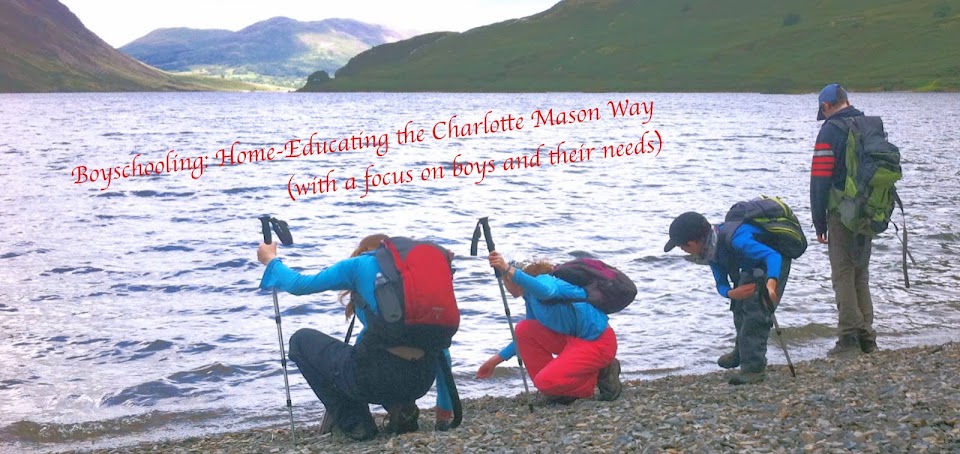
Homeschoolers in the Hills

On this trip, though, I became much more aware of how homeschooling is a whole package, that even on holiday, we are still teaching, learning, exploring, and best of all, growing as people.

Let's take Lesson Number One: how you have to persevere, even when it's hard.

Ascents can be exhausting!

This is a great lesson to learn as you climb up mountains. Yes, it's hard, and yes, it's tiring, and yes, it sometimes hurts -- but you can never quit, because there's no other way to get home! Encourage each other; make up games like how many steps you can keep going in a row, or who can suck a sweetie the longest; keep your eyes on the goal ahead (ten more minutes, or keep going till that crag up there, or the summit's just around the corner); above all, put one foot in front of the other till you succeed at your goal.

Life can be like this.  Whether it's swimming training or races, which is our sport of choice, or reading a long novel, or later on, when one is in business, at university, or trying to keep a marriage going -- JUST KEEP GOING!!! It may be hard at times, but you can do it if you don't quit.

Lesson One: Never give up!

What about Lesson Number Two: climbing mountains is a team game. We have particular difficulties with Rocky and Timmy, trying to push past each other to the summit and knocking each other to the ground. Tears, cuts, dangerous behaviour, not to mention embarrassing arguments on the hills which reverberate throughout the quiet valleys.

Winning is not always the goal.
Having recently discovered cooperative board games like Pandemic, this concept was readily accepted once we discussed it at length: there are no individual winners or losers when climbing mountains, but we ALL win when we get to the top.  Conversely, if anyone loses (ie, injured), we ALL lose, we ALL fail to reach our goal, we ALL have problems in trying to get back to the safety of the car/cottage/cafe.

Work Together to Achieve the Goal!
We even had a Lesson Number Three that was specifically about school -- what do you do if you read books but don't understand them? Rocky is particularly keen to keep up with Killer and Phoenix in their book choices, tackling titles like "Dracula" and "Divergent" on her Kindle, but not understanding what's happening in them.

This lesson was for me: "Clearly," I said to her as we trudged up the 2600-foot summit of Grisedale Pike, "I need to spend more time reading aloud to you so you can better understand these hard books."

Rocky marches to her own drum.
She's such an independent soul that she often gets cut loose on projects herself, but I need to remember that she's only 9 and still needs the same level of nurturing that my more needy kids need.

In homeschooling, no child need be left behind.
Education, like life in general, should be a team game, and sometimes, the coach needs to do a bit of coaching to ensure that we're reaching our goals.  For me, the goal is to make education an atmosphere, a discipline, a life -- these are the words of Charlotte Mason, a Victorian educator and originator of a popular homeschooling method, and the words that we live by, whether in the school room, in the living room, or in God's great outdoor room!


Wednesday, 16 January 2013

What about chores?

Chores, chores, chores! They gotta be done, but how do you go about it -- especially when the kids are home 24/7, and you've got more than a full-time job trying to run a household and teaching your family (not to mention the other balls you're trying to juggle in the air, whatever they may be)?

Everybody needs to pitch in!

Over the years, I have read books like Managers of their Homes, and more recently, Homeschooling at the Speed of Life* which are very good about scheduling, but I usually find -- as I'm sure most of us do -- that one person's plan for organising the household isn't always exactly right for my family.

So, right now, I do two things with my four kids.  I give them regular, almost-daily chores, and I give them a Monday job, a Tuesday job, etc.  

We call these once-a-week jobs "fish jobs" because I once saw an episode of Supernanny where she had the children use magnets and string as fishing poles to catch magnetic little fish with chores written on the back.  

We, too, once fished for our jobs, but because my kids like routine -- and I like practice till perfection! -- we never fished for the jobs again and just kept to them until they were outgrown and passed down to younger siblings.

My older two -- who are 12 and 10 -- receive salary for these chores.  My younger ones -- who are 7 and 5 -- have chore charts.  They put their stickers on when they complete their chores, and they get paid 5p each, with an opportunity to win a morning at the coffee shop with Mommy if they ever do all their jobs for four days of the week.  (This has NEVER happened up till now).

Busy Timmy's Chore Chart

If you want some good ideas about which chores are age appropriate, you can just Google "age appropriate chores".  Here is a link to one version by Focus on the Family.

Sometimes, having a chart is a good way for ME to keep honest about what jobs need doing.  For example, I'm not very good at making my kids practise their instruments, even though I should be very strict about this.  Having the instruments on their list makes them become responsible for themselves -- they see it, know it needs to be done, get on with it, put on the sticker, etc. 

We're all happy, then!

Putting violin practice onto Rocky's chart
helps her remember to do it
(it's also in her school schedule for a double reminder
because she can be forgetful ...
usually on purpose!!!)
I have been on many forums where a discussion ensues regarding whether or not to pay children at all for their chores. I think I got convinced about paying children from Dr Dobson's New Dare to Discipline book, which basically said we, as adults, are almost always able to discover reward in whatever we do, money-wise or not.  I mean, I really, really hate to do the dishes, but I know there are myriad good reasons for doing them. 

Children, too, deserve to see the reward in what they do, but they probably aren't yet mature enough for seeing rewards in a job well done, like we are, unless there is tangible and short-term evidence for it.  Money is one option.  I have also used pocket-money toys in the past, where they could trade a certain number of stickers for a yo-yo or something similar, but the toys were so cheap and made such stupid clutter, I decided I'd rather give them money.

In the end, I would rather pay my children for doing their jobs than give them pocket-money for nothing.  They are learning about saving, spending, and giving; they are learning how working hard achieves more reward. 

Best of all, I can see them all starting to pitch into household success without always needing to be paid -- helping out in areas which aren't on their chore charts or their lists -- and I guess that's what I'm ultimately after.

Making lunch has its own rewards!
*I haven't finished this book yet, but so far, I like its practical, down-to-earth approach.

Monday, 28 June 2010

In praise of hotdogs


I'm not talking sodium nitrate and colouring and collagen casings here -- I'm talking a fun game that you can play with your children that's especially useful if someone is upset or grumpy or out of sorts.

First, I'll admit that this game wasn't my idea. I got it from a book called "The Out-of-Sync Child Has Fun" by Carol Stock Kranowitz.

An "out-of-sync" child has many guises: over-hyper, total couch potato, extra-clumsy. All these symptoms and several in between could be indications of Sensory Integration Disorder, where a child's brain doesn't quite register senses properly.

I still haven't decided if my 7-year-old has a form of this -- he definitely requires over-stimulation to feel right, such as going to bed with a flashlight shining in his eyes and never being able to find his "inside voice". I've decided, however, that the label of SID isn't as important as Kranowitz's suggestions for tackling it, which is basically to ensure children have a varied sensory diet just as one would ensure they have a varied food diet.

"Hotdogs", therefore, are one "dish" in the sensory diet, and one particularly enjoyed by children who like deep touch. The key is to press deeply and deliberately, because children who have sensory issues might feel uncomfortable with soft touching.

Here is our variation. First, the child lies on the ground face down, then we mime turning on the stove and starting to "sizzle" the hotdog by jiggling him. After a few seconds, we turn him over to sizzle the other side. We turn the stove off, then start slathering on the condiments:

  1. ketchup (long, slow strokes from head to toe) 
  2. mustard (splodgy pushes up and down the body) 
  3. onions (poking all ten fingers along the length of the body) 
  4. pickles (using the forearms, press from head down to the feet) 
  5. cheese (a bit of a feathery tickle) 
  6. chili (long stroke followed by a press, which is the sauce followed by the beans) 
  7. finally, the bun, which is your whole body on top of his. You can pretend to eat him now, or if he's too tall for the bun, pretend to cut off his head. (I think this a bit morbid, but they seem to love this part ... go figure). 
With my hot-and-cold, intense 7-year-old, this game has become something of a tantrum buster. He's even offering to do it to the other children when they've had some kind of upset like a scraped knee, so I know he has come to regard it as a soothing therapy.

Meanwhile, if you want to know more about SID, then do consult Kranowitz. You may find that she finally nails the difficulty you've been having with your own child, and what's more, gives you some strategies for dealing with it.