Showing posts with label Charlotte Mason. Show all posts

Thursday, 14 September 2017

Training Your Child Part 3 - The Interview with Vicki Tillman, Part 1

As promised a few weeks ago, I am publishing the results of a long-distance interview with Vicki Tillman, one of the "7 Sisters" at http://7sistershomeschool.com/ and a professional life coach.


"Our Vicki" at Seven Sisters and Homeschool High School Helps


She was kind enough to agree to help me in my term-long exploration of my children's own career paths, something originally sparked by our reading Chris Hadfield's An Astronaut's Guide to Life on Earth.

So here is the first part of that interview, basically copied and pasted from our notes. They make excellent reading and Vicki is full of great advice.


Kat, this was fun! Thanks for the opportunity!- Vicki


1. Judging from the timeline on your website profile, I’m assuming you explored your own mid-life career change before helping your homeschooled children work through theirs - what advantages do you think homeschooling parents would gain from re-visiting their own career goals before nurturing their teens’ goals? How should they do this? Good question, Kat! I did actually go back to work after being a stay-at-home homeschooling mom. I homeschooled and worked. In order to do that sanely, I needed to work in a career that would be life-giving to me so that I wasn’t too drained to enjoy my time with my family. It took prayer and an honest look at what God had created me to do. At that time, I wasn’t trained in Career Exploration but that’s what I did for myself: I evaluated my God-given strengths (people have always come to me with their problems, I’m a good listener, I’m intuitive). I evaluated my weaknesses (I can’t count, I’m not great at details). I evaluated my family’s needs (homeschool schedule, support systems/activities involvement, budget). I evaluated my values (time with family/flexible schedule, time to homeschool and go to church). All these put together pointed to one career for me: Counseling (which eventually naturally added Life and Career Coaching).

2. I’m rather assuming in question 1 that career goals are first explored during the high school years, but are there things one can do with one’s children prior to that?
Oh my, yes. When children are young:
  • We read biographies of great role models 
  • We introduce them to leaders and good people and diverse kinds of people 
  • We teach them life skills, manners, service and good character
  • We teach them awareness of God, themselves, the world God made
  • We give them many different experiences (like field trips and choirs and science experiments and history projects and writing assignments…)

All of these are early Career Exploration because the basis of Career Exploration is self-knowledge and experiences!

3. I’ve been watching my own children for a long time - a bit like Jesus’s mother, Mary, who treasured up things in her heart when Jesus was a boy - however, most of what I’m seeing is children with weird, whacky, and impractical career goals. One of them wants to be a frog! How do you discern the dross from the gold?
Ha! One of my kids wanted to grow up and be a lizard. He’s now working on his PhD in Comparative Literature. My advice is to hold the idea of careers lightly until they enter high school. Let them enjoy learning about themselves, God, people and the world around them. If you see a strength, give them opportunities to develop that strength without taking the joy out of it. 

In high school, I definitely suggest teens do a Career Exploration course. Every teen is different:

  • Some of my kids have done this in 9th grade just to get the ideas flowing (but not making a career decision). Then they repeat the course in 11th grade. 
  • Some of my kids only needed Career Exploration in 11th grade because they had some sense of direction early on (at 11th grade they simply needed to clarify and solidify their decisions).

4. You advocate a wide swathe of experiences for teens as part of their career exploration, but what about the teen who knows exactly what he or she wants to be at a young age?
Yes, every teen is different. I had one teen who wanted to be a photographer from the time she entered high school. I still had her do a Career Exploration course to help her solidify her decision (so that she would not feel regrets 1/2 way through college). I also gave her a few non-photography electives in high school that could broaden her experiences. However, the bulk of her Fine Arts and elective credits were Art and Photography related. (BTW- she is a college graduate now and a successful full-time photographer.)

5. Is there a clear step-wise approach to career exploration, or is it a more organic experience?
There’s not one right way to do Career Exploration. However, the steps I’ve done with my teens have been based on: 
  • Self-knowledge (What are their God-given strengths, weaknesses and personality?)
  • Knowledge of God’s leading (What are their experiences, role models, understanding of God’s working in them- through understanding God’s workings, listening to others’ input, knowing self?)
  • Clarification of values (What is important to them in career/lifestyle: time, leisure, community/church involvement, family, finances?)
  • Knowing what’s out there (What can they learn from career interest tests and exploration of career descriptions/outlook/education/salary?)
  • Trying on hats (Can they shadow, interview or apprentice?)
  • Development of job search skills (Help them create mission statements, resumes, cover letters and learn interview skills.) 
(BTW- This is exactly what I’ve done with my kids and hundreds of local homeschool high schoolers… and what is available in 7SistersHomeschool.com’s Career Exploration Bundle.

6. What happens when your child is desperate to be, say, a rock star and … ahem … they really can’t sing or play an instrument?
Yeah…I’ve run into that a few times over the years. Failure is a good learning experience. If you can allow them to have some experiences during high school in their “want-to” field, the lack of giftedness usually becomes clear to them. Then, you can lovingly help them explore something more realistic. 
However, if you give them the opportunity to fail and they still want to pursue, you can talk to them, tell them what you’re willing to help fund or not and then see how hard they are willing to pursue that dream on their own. I know one mediocre guitarist who scraped through a music major in college thinking he would be a rock star…and he did end up in the music industry in a totally different job. He planned his way but God directed his path.

7. Along the same lines, what about a child who wants to be a receptionist when they grow up, which I think of as the kind of job that teens have part-time in the summer because they’re not really careers?
That’s when you go to CareerOneStop.org (US Department of Labor) and explore that career’s training requirements and income. Then do a good Financial Literacy course with them… On the other hand, Office Managers (upscaled receptionist/admin) make some pretty decent money.


This is the end of Part 1 of Vicki's interview. Be sure to subscribe to the blog so you can get Part 2 of the interview sent straight to your inbox.

NB: Vicki and her colleagues invited me onto their Homeschool High School podcast back in June. You can still hear our discussion about the US vs the UK homeschooling scene at this link here.

Wednesday, 16 August 2017

Planning for 2017 - Step One

I'm cutting it really, really fine. We're less than a month before we're going to start school, and I haven't really made my plans for the year.

Looking for inspiration in the stars

I thought it might be fun - perhaps instructional - for other homeschoolers to watch me fumble through my plan for 2017-2018.

As you may have gathered if you've followed me for any time, I have four children aged between 10 and 17, and I teach them all together using the Charlotte Mason method.

aka Killer, Rocky, Phoenix, and Timmy


There are shades of interpretation for the CM method, and while there are a lot of purists out there, I'm not one of them. To my mind, Charlotte Mason - genius as she was - was still a classroom teacher and planned, implemented, and managed her philosophy via the lens of being a classroom teacher.

I know ... sacrilege, right?

Well, I'm a former classroom teacher, too, and know for a fact that what one does in a classroom is not what one necessarily needs to do in their living room with their own children.

So, I have taken to heart CM's short lessons, living books, narration/copywork/dictation, while devising my own plan of subjects and scope/sequence.

We always study the Bible, memorize Bible verses, use a math curriculum for each child such as Life of Fred or Shillermath, and then have a stack of books for English literature, philosophy, science, biography, spiritual lives, history, economics, and geography. We work through our stack a little each day, reading in 15-20 minute intervals, and by this step-wise approach, we will usually complete many of the books we start out with in September. (If we don't, we just let them carry over till the next year).

Here's a book that took us over 2 years: celebration!


Added to this, we have a weekly co-op in my house. Last year, we studied Texas History and Biology. Tomorrow, I'm going to discuss with my colleague about this year's plan, but it looks like it will be US Government and Chemistry.

My high schoolers have also been attending outsourced online courses for five years now: both have completed four years of English, and now are working their way through Ancient History and Spanish. All these are undertaken with Dreaming Spires Home Learning, my own international tutorial company where I'm in charge of the English.


Online doesn't have to mean isolated

But what will be our book list for our morning time together? And how am I going to implement my new planning approach with simple spiral notebooks?

These are the questions I'm seeking to answer over the next two weeks, and you're invited to join me on my journey.

Even homeschoolers with more than a decade of experience will have their confusions, uncertainties, and conundrums. What we probably also have is an overall vision for our kids, and an underlying routine.

Tuesday, 27 June 2017

New Interview of Kat on National Podcast

In 2016, my family was featured in a national UK newspaper about our homeschooling journey (see this link here: http://www.telegraph.co.uk/women/family/hating-the-new-sats-meet-the-mums-who-chose-home-education-over/)
Today, I appear on a national podcast in the US, focusing on the differences and changes when homeschooling in the UK and now US.


Please share the link to it - Vicki Tillman and the gang at 7sistershomeschool.com offer a wonderful support group for homeschoolers at all stages, being veterans with many years of experience under their belts.

You can even subscribe to their podcasts, and their recent series about reading and writing for high schoolers was very interesting.


Thursday, 23 February 2017

When You Meet Your Heroes - Part 2

Back in November 2014, I wrote a blog post about hosting my hero, Sally Clarkson, in my home in Oxford, England, for a lunch date. This is a follow-up post after I attended her Renew My Heart conference in Dallas, Texas, last weekend.

Meeting Sally for the third time in my life

First of all, if you don't know who Sally Clarkson is, I would suggest it's time to get acquainted. She and her husband wrote my all-time-favorite homeschooling book, Educating the Whole-Hearted Child. She also wrote my second-favorite homeschooling book, Seasons of a Mother's Heart.

These were some of her earlier titles, first published around the millennium but now updated and re-issued.

Basically, her books were (and are) a lovely blend of experience, wisdom, and well-told stories, all based on a Godly foundation. She has since moved into a more supportive role for Christian mothers everywhere, releasing titles like Mission of Motherhood, Ministry of Motherhood, and her latest, Different, which is about nurturing that difficult child through the "dark years" and emerging with a beautiful butterfly of a mature young adult.

I've come across Sally in person on two separate occasions: the first was in 2005 when she was visiting a homeschooling friend of mine near Oxford, England, and the second was the lunch date in 2014. Throughout all these years, I have been privileged to share Sally and her work with my sister-in-law Holly, long distance because she has lived in Dallas and, until June last year, I lived in England.

Holly has also drunk deep of Sally's wisdom through publications, but also, she has attended two conferences in the past. Yet, it has always been our dream to go to one together, so this past weekend, we were able to share our love for Sally and her guidance at the Renew My Heart conference.

Holly and I avoid the book stalls

Sally's conferences are amazing. Yes, there are hundreds of people there, but Sally is walking around the book stall, signing people's dog-eared and highlighted copies, swapping stories, and in my case, renewing our old acquaintance. No prima-donna, but accessible and making time for everyone.

"What are you doing here?!" was the first question she asked me. When I said I'd finally made the move I'd been seeking for so many years, she was quick to praise God for His goodness!

The conference itself seems to be one of the last ones she's planning to do, hotel rental being expensive when compared to the new social media outlets available. I found it a wonderful chance to meet new people since it was based around table groups, but there was also plenty of guidance and space to go off by ourselves and listen to God's heart.

My own quiet time could not have been more refreshing. I took off down the footpath around the man-made lake, thinking how great it would be if I could find some trees and, if possible, a fountain of some sort. I didn't really believe that would happen, but next thing I know, I'm at the head of the reservoir where the spillway is chucking down a sheet of flowing water. The sound was powerful enough to drown out the sound of the highway nearby - a reminder that God's Spirit can drown out the noise of life if we put ourselves in the right place.

Refreshing Water and Quiet Thoughts

Two more revelations came out during this time alone. One was that I needed to remember my calling - to home educate my children. If I was putting other things in the way, then I needed to re-calibrate. This led to my re-think of the schedule I've got for teaching English online to other homeschoolers. The fruit of that re-think has been announced for September 2017: no more classes during US morning time (except the day when one of my children already has an online morning class for Ancient History - I had to make at least one concession to my students in Dubai!).

With five minutes left of the quiet time, I lay back and look up into the trees. "God, tell me something. Give me a word. A picture ..." Yeah, yeah. In five minutes. Now .... go!

God rarely works that way, I know, but He was very good to me that day. He did give me a word. When Sally visited back in 2014, I always said I felt like Zacchaeus, hearing that Jesus was going to come to dine at his house that day. This time, God said to me, "Look at the tree ... it's empty. Zacchaeus is no longer having to work at seeing Jesus, but is now one of His intimate friends." The flood of acceptance for myself as a friend of Jesus was immediately clear. I returned to my table group so full of God-inspired refreshing - RENEWAL, just as the conference was aiming to achieve.

If you want to go to one of Sally's conferences, there are still two more planned for the year: South Carolina in March, and Oregon in May. She's also in London on March 18th. At our conference, people had traveled from California, Canada, New York, so if you have the time, you should get to one of these before she doesn't offer them anymore, even if it means a weekend of travel.

You won't regret it. She is a living hero of Christian homeschooling parents everywhere.

Wednesday, 1 February 2017

Planning for History in a CM way -- Texas History for High School


Let me take you on a journey - the way that I apply the Charlotte Mason method to a subject like history. In this case, it’s Texas History, a requirement for public-school children in this state at both 4th grade and 7th grade, and again, at university.

Of course, as homeschoolers, we didn't have to do this study -- ever. However, we decided that we would because my kids have grown up in England and only just moved to my home state in June 2016. It also would be a great way to invite along some other homeschoolers in a co-op, and widen our social circle.

In Texas - time to study Texas history!


The challenge was to map a well-documented study that's normally for ages 9/10 and 12/13, onto a more rigorous expectation for high schoolers. Further, to move away from the textbooks used at these years and even at college, and find some living books that would cover the sweeping timeline of the territory.

Just a reminder of what I mean by a living book — 

  • A book that engages the reader and draws him or her into learning more about a subject; it is typically narrative in style and written by an authority on the material. Living books are written by someone with a passion for the material or by someone who has experienced the story first hand. - Sassafras Science

Textbooks are not living books, in general. There are some exceptions, such as the Exploring Creation books by Jeannie Fulbright from Apologia Science.

Another criteria for choosing books was avoiding twaddle. Twaddle means probably what you think it means — books that are silly, babyish, basic, usually bitty, full of pictures without extended text. Texas History has a lot of this rubbish on offer, probably because it’s a school subject and publishers can get away with quantity over quality.

Once I established the kind of book I was looking for, it was time to scour Amazon. I love Amazon because you can input a book title - for example, even the textbooks — and check out the related titles that come up in the search bar.

In some ways, though, I got to cheat on this step. I knew a living book that we used years ago, when I touched on the history of the Alamo with my children almost ten years ago. The book was called Journey to the Alamo by Melodie A Cuate. It’s one of those stories where modern-day children get whisked back in time by a magical trunk, and find themselves in the midst of the battle. Not especially strong for the high schoolers I was teaching, but a favorite for the middle-grade kids, and helpful for the search threads on offer when looking on Amazon.

I also googled Texas History and homeschooling, to get the way that other parents have navigated this subject before. No reason to reinvent the wheel, right?

Finally, I went to my library to expose myself to the bigger picture of Texas history than I remember from my own 7th grade education. I’m lucky that my local library has a very creditable collection, its shelves fairly full of Texas-related living books in the adult section. It was here that I hit on the best find: my spine book of the year.

“Good-bye to a River” is a memoir by John Graves. He wrote it in the 1950s after taking a canoeing trip down the Brazos, stopping by many of the homesteads of people whose family traced roots back to the 19th century. He picked up lore and legend, myth and hearsay, and as he floated down the river, camped on the shores, fished and hunted and tried to keep his puppy warm and dry, he took the experience and turned it into a repository of some of the last memories of people who had been there in Texas’s early days of settlement.

That is, settlement in the northwestern part of the state, a place that remained wild and dangerous until almost 1880, and rarely included much in the narratives of the southeastern portion and its famous six flags.

The only problem with the book is that it has its moments of gruesome raids and scalpings, so it’s in need of some editing and generous warnings about certain chapters that one should probably skip entirely.

My second book of choice was Sam Houston’s Republic. It came highly recommended on homeschooling sites, and the first pages seemed promising. Definitely a living book, but ever since buying it and trying to push through it, I’m backtracking. It’s not very well written, extremely digressive, and the kids literally groan whenever I open it.

Not a good sign.

These two books are working as our spine - the books that I use to take information from and discuss in our meetings. We also lapbook/scrapbook our sessions, building up a picture of regime change as we journey from Indian ranges, to Spanish and, to a lesser extent, French territory, Mexican colony, independent Republic, and the difficult years of unity and war. The overall idea is to vist the six flags of Texas while acknowledging the ever-present danger of the Comanche peoples to the north.

Six flags of Texas - with a Seventh!


We also have a bank of books that we’re reading and enjoying as bedtime reading or independent reading.

These include the remaining titles of Cuate’s Mr Barrington’s Trunk series, of which Journey to the Alamo was first. She followed this by San Jacinto, Goliad, Gonzales, Galveston, Plum Creek and La Salle’s Settlement. If you have middle schoolers, you could do your whole year of Texas history by reading this series. The only problem is that it’s expensive to buy, so make your library do it for you!

Another series that we’re using is written by Janice Shefelman. Titles include Comanche Song, Spirit of Iron, and Willow Creek Home. She also writes a book about German immigrants who arrived in Galveston (A Paradise Called Texas), one of the most important eras of Texas history when it comes to my own family! 

The Cuate and Shefelman books are great for 5th-7th grade, but not really great for high schoolers. We read them anyway as a family for fun, but sometimes the way to push the older students is to turn them loose and make them discover their own info. We’ve completed one sub-section of our study when, over Christmas, they had a bird-watching project to complete.

Big Boys do Scrapbooks


Next, because we’re entering the era of the Republic, we’ll be exploring origins of our Republic luminaries like Travis, Crockett, Bowie, Houston, and Fannin, each high schooler responsible for researching one of them. We’ll also be combining the middle schoolers and high schoolers for a salt dough recreation of the Alamo.

A trip to San Antonio is de rigueur as the weather improves, too!

I hope this blog post has accomplished two things: first, given you insight and perhaps encouragement that you can choose your own era of history and make it part of a Charlotte Mason education, particularly with its emphasis on living books. I should say here that I’m not saying that this alone is “the Charlotte Mason method”, but part of a whole philosophy that includes all the other subjects and various hallmarks like copywork, dictation, nature study, etc.

However, people often ask on social media about how to design their own CM-style history curriculum, so this post will probably give you an idea of the process.

Second, if you need ideas for Texas History, this should give you, at worst, a head start!


Sunday, 25 September 2016

The Three Pathways of Homeschooling

This is going to be a long post. I apologise in advance, but I encourage you to read it, and read to the end: it could fundamentally change how you educate your children at home.

You see, every August/September, I have a crisis of direction.
  • Even after doing this for 13 years.
  • Even after becoming a firm believer in the philosophy and fruits of the Charlotte Mason method. 
  • Even after applying all the good parts of public school that I learned as a teacher there, and knowing what to discard and what to bar completely from entering through our doors.

You’ve probably felt this way, too. In August and September, everyone starts shouting what they’re planning to do for the year — singing the praises of this curriculum, or that program, or about exams or credits or dual-enrollment or American style or whatever, and you think:

… maybe … I’m … doing … it … wrong.


Chances are, you are doing it wrong. Almost all of us are. Me included.

Let me explain.

First of all, I think there are basically three pathways to education, particularly home education. You can see from the introduction that I have certain biases, but we’ll probably all agree on the general principles I’m going to run through.

Number One Pathway: the school-at-home way

I call this the “world’s pathway” — that is, following the way that most people’s countries go about this whole education thing, and the fall-back position for most homeschoolers. It’s what we know, right? The bottom line of this pathway is that students are drilled in an effort to achieve pieces of paper. In some cases, they’re not even drilled: they just end up with pieces of paper because they’ve signed up for something and then proceed to teach themselves. Let me explain:

My teen has just signed up for her first “dual-enrollment” course at a local college. It’s an online English class, and it consists of reading some chapters of a book, writing a paper, and emailing it to the teacher. The teacher them writes back “accepted” or “not accepted”. If you’ve ever read T H White’s Once and Future King, this might remind you a lot of the ant colony where things are either “done” or “not done”. This seems the pinnacle of factory education to me, where a teacher runs a course only in name. All the real learning has either been done by the student before, or the student doesn’t get any real learning or … surprise, surprise … Mom does it! However she gets there, her ultimately outcome is simply this: Done.

The problem with the world’s pathway is that the outcome of “done” is what’s important, not the process along the way. Children can cram and vomit out the expected answers, then go on their merry way, none the wiser.

This is true of so many homeschool approaches, too. Don’t kid yourself: if it’s short answer, fill in the blank, multiple choice, the level of learning is minimal, and the aim, at the bottom of it all, is to be “done” or “not done”.

Number Two Pathway: focus on the process of learning

Now we come to those home educators who have opted for the second pathway, that is, learning for learning’s sake. There is no sense of “done” and “not done”, but of “doing”. They have eschewed the hoops and hurdles of someone else’s idea of success, and focus instead on the process of learning. There are different ways of achieving this aim, and some are very rigid while others are very loose; however, they don’t settle for “done” and “not done”, but are pushing the learning outcome to something lasting. This would be more your Classical Conversations, your Charlotte Masons, your Montessoris and other “living” approaches, including (to some extent) your unschoolers. Curricula and texts and activities work on the nurturing of the learner.

Clearly, as a Charlotte Mason advocate, I find this approach preferable to the first. I’ve been in the done/not done environment as a teacher, and I can spot a done/not done curriculum from a mile away, even if it’s dressed up as something else. The second pathway is clearly a higher level of learning for the student. It takes students further, deeper, broader; expands their level of brain development, motivation, retention; and turns them from “done/to done” or input/output machines into organic, holistic creatures made unique and, theoretically, more adaptable to what life throws at them.

I’m constantly trying to encourage newbies to leave the first pathway and branch out to the second one, because the first one usually leaves them feeling burned out or insufficient teachers, leads them to lots of shouting fights with their kids who find it boring and uninspiring, and therefore, prevents the warm, fuzzy feelings one was expecting to have when teaching one’s children at home. 

Almost everyone who has changed from pathway one to pathway two, if they were having problems, is happier after the change, because it suits their vision of what homeschooling would be like when they were thinking about doing it once upon a time.

PATHWAY ONE IS A LIGHT SWITCH


PATHWAY TWO IS LIKE AN AMOEBA


(Pardon my analogies … I’m doing my best!)

However - and grab onto your seats - BOTH PATHWAYS ARE WRONG!


The right pathway is pathway three. If you’re religious, it’s God’s pathway, but even if you aren’t, don’t give up … I’m not going to cram the gospel down your throat. I’m going to tell you something amazing about how to educate your children at home.

Or, maybe I should say “WHY” you educate your children at home.

You see, your educational philosophy — whether religious or secular — has a spiritual or philosophical or at least a moral element to it. I mean, if you’re trying to sit down and read a book with your kids or make them read a book, but they’re fighting instead, and you just say something like, “For goodness’ sake, can’t you just get along like good people do?!!!”

What about, “It’s not nice to hit.”

“Don’t call people names — it’s not nice.”

“Only bullies act like that.”

“Share.”

You see, the fundamental things that homeschoolers do — all of us — is instill our absolute values in our children.

Does that make you shudder? Maybe it should. You know, a Neo-Nazi white supremist family who homeschools will be inculcating their Neo-Nazi white supremist values to their kids. A free-love naturist hippy who homeschools will be passing on their free-love naturist hippy values.

Maybe they’re Muslim extremists, Christian extremists, atheist extremists, socialists, drug-heads, welfare “spongers”, Asian Tiger Moms, or even Republicans, Democrats, Greens, Libertarians, monarchists, anarchists …

Hopefully, you’ve got the point.

Just to be clear. I am absolutely not making the point that the government should “do something” about all these different isms and ists who are homeschooling their children. For one thing, no government could possibly succeed in preventing parents from passing on their values short of removing the children from the family. Even sending children to school for 6 hours a day, 5 days a week isn’t going to stop the family values from creeping into a child’s moral fabric. 

Perhaps naysayers would argue, “Well, at least they’re getting an alternative view to their parents’ weird ideas!” No, they’re getting a whole new set of ideas, few of which are helpful or preferable. More on this in a minute.

Schools, because of the plurality of the student body, can’t espouse any unifying message of morality beyond the most diluted “be good” (ie, shut up and be quiet and don’t make any waves). Clearly, it can’t put forth any religious position of absolute truths out there, or there would be major ructions. It can’t be wholly secular, either, because there are no agreed guiding principles if you have no agreement on “absolute truth”.

All the schools can do is hope that their “be nice” message and “work hard” hopes will filter down to some sort of general order, but we all know how well that’s succeeded. Even if you personally haven’t been struck down by major tragedies like mass shootings, you or someone you know will have been badly hurt by bullying — this might not be a national tragedy, but it’s darn well a personal tragedy for millions of children, all of whom relied on the school to teach a value system.

No. Schools aren’t where the value systems of worth are found.

So, legislate as they might, governments will never replace the moral compass of a child’s home. That means the only place that your child can set his or her moral compass is at your hearth, and that means the chief end of homeschooling — whatever your religious or philosophical beliefs — is a moral one.

If you’re a Christian, this is a clear-cut direction. You use the Bible to study more of who God is, who you are in God, and how that impacts on your unique mission in life. According to R C Sproul in his excellent book called When You Rise Up, this will include equipping your children to teach their own children, who in turn will teach their children, etc.

It is an impactful pathway!

If you’re not religious, then you may like to use the two fundamental principles of natural law as set out by Richard Maybury in his Uncle Eric series of books:
  1. Do all that you say you’ll do
  2. Do not encorach on others or on their property
These two fundamental principles will get you a long way amongst fellow humans in the world.*

So let me re-cap:

PATHWAY ONE - Homeschool in a way that follows input/output methodologies, where study is a means to an end like credit hours, exam grades, degrees, and a good job. This way serves a purpose.
PATHWAY TWO - Homeschool in a way that seeks learning for the sake of learning. Qualifications may happen along the way, but you’re mainly trying to equip your children for skills they’ll need throughout their lives, come what may. You focus on process more than you focus on outcome. This pathway also serves a purpose.
PATHWAY THREE - Homeschool in a way that’s mindful of the moral messages that you teach your children, both by study and by your life in words and deeds. You set the bar of what success actually means, both in terms of academic and personal success. You know a child can always learn from a book, even after having left home, but the moral compass is set when they’re young and at home. Your studies, therefore, are not taken in a vacuum. Even something like Texas History can discuss the moral issues regarding clashes of cultures and needs/wants, and these discussions can help them tease out the hard choices when they’re adults. This pathway not only serves a purpose, but serves a society.

So, if you don’t take PATHWAY THREE, does that make you a bad homeschooler?

I think it’s the wrong question to ask. You signed up to pathway three the moment you started having children, so it’s not a matter of “if” but of “when” you start walking this way.


Parenting is about journeying with your children.
Setting your child’s moral compass is a fundamental purpose of being a parent, and therefore, you should look into using every and all resources for fulfilling that purpose. Of course, moral compasses will differ from family to family. That’s the problem of our having free will because we’re human beings. I mean, clearly it isn’t for us to decide whose free will is allowed to be free, and whose isn’t.** 

Just by focusing on principles, you’ll be teaching your children that there are such things as absolutes, and that’s a eye-opening lesson in today’s relativistic world.

Having a generation of homeschoolers who know that there’s such a thing as right and wrong will be a great influence on future society, and possibly position them to be world changers.

Be careful: you’re not nurturing them so that they can be world changers … instead, you’re nurturing them first and foremost to be moral/kind/godly, and then they CAN be world changers.

SO TAKE COURAGE, MOMS AND DADS — WHEN YOU THINK YOU’RE JUST STUCK AT HOME AND NOT MAKING A DIFFERENCE, YOU COULD MAKING A WORLD OF DIFFERENCE!


*Of course, religious people would urge you to think beyond the tangible and limited world that we see, and consider the spiritual world beyond — but that’s another topic to save for another day.

** It’s easy to get self-righteous and judgmental here. Remember to take the plank out of your own eye before you point out the splinter in your neighbour’s.


Saturday, 22 August 2015

Schedules, Schedules, Schedules

It’s that time of year. Facebook and blogs and Yahoo groups and forums are full of people’s schedules. I used to write mine up in great detail on Excel — talk about Throwback Thursday (even though it’s Saturday!)

Here two of my schedules from the past:


Best laid plans of yesteryear


And what about now? How do I home-educate four children between the ages of 8 and 15? Well, now my schedule looks like this:

My plan for this year


How have I gone from ticky-boxy to book-stacky? Basically, three things have changed in the past two years:

  • I have fully embraced the idea that homeschooling is as much as about a relationship among the family as it is about a relationship with our studies, and therefore, I’m committed to teaching the kids together as much as possible.

Homeschooling is so much more than just studies

  • I have fully embraced the idea that recording what we’ve done is as successful an approach as planning what we will do: more so, in fact, because the stresses of “falling behind” are gone entirely, and the joys of “capturing the moment” are here to stay.

Recording what you've done is less
stressful than planning what you might do

  • I have fully embraced the stage of the children’s lives that they can both work together, and work independently; this means that we study together in the morning, and the afternoons are free for play/handicrafts/Spanish/music lessons/hobbies, or further studies for the older two.

Afternoons are free for hobbies

Sometimes, my friends accuse me of being very off-hand with my approach, as though it’s as easy as falling off a log. I think I give this impression because I’ve been homeschooling for twelve years now. With time (and children’s maturity), one tends to grow into their individual rhythm.

However, if you want to embrace an all-together policy of home-education as I have, then it's possible for you to start now. Here are some suggestions.

First, following a flexible educational philosophy like the Charlotte Mason method. Sometimes, her method is made to seem overly complicated if you look at various websites. The hoops to jump through are made to seem overwhelming, as though each child has to have his or her own complete curriculum, and therefore, you have to spend your entire day in leaping from one child to another to support their studies.

To me, that’s the way to madness.

This is what madness looks like

Look — what they tell you is that their way is a CM curriculum, and I say to you that my way is a CM curriculum.  In fact, both ways — all ways of homeschooling — are curricula, because the definition of curricula is those subjects which you study. If you happen to study the lyrics of Janis Joplin songs 24/7, then that’s your curriculum. It doesn't have to be someone else's pre-set way of educating your children.

It’s a bit like saying you’re on a diet. Everyone is on a diet. Diet is what you eat. Some people are on a low-fat diet, or a low-protein diet, or a low-Starbucks’-vanilla-latte diet, but a diet is just describing that which you eat. Period.


That's the English Cream Tea diet

So my curriculum is the collection of subjects that we’ve chosen to study, and we do so by using the Charlotte Mason method.

Charlotte Mason, by the way, was a Victorian teacher whose forward-thinking ideas about education continue to be ground-breaking when it comes to churning out thinkers instead of hoop-jumpers. (She would have abhorred today’s focus on teaching to an exam rather than igniting interest in a subject)

In short, the CM method is characterised by:

  • short lessons
  • use of living books as opposed to dry textbooks
  • employing narration, dictation, and copywork for Language Arts skills
  • nature study
  • art- and music-appreciation
  • free afternoons to work on handicrafts, outdoor pursuits, or other personal interests


Our CM-inspired timetable consists of reading really good books for about 20 minutes each, sometimes getting to six or seven of them in a morning. We rotate through about twenty books at a time, and generally they have a similar theme. 

This autumn, we’re focusing on North America at the time of the early explorers, including the indigenous peoples who already lived there. Our science is botany with a focus on trees. We use Life of Fred for secondary school, and a mixture of Singapore and Shillermath for primary. We’ll also dabble in artist study, composer study, quantum theory, Shakespeare, US politics and economics, character study, and of course, biblical history and Christian faith.

We’ll work our way through this whole stack of books in the year, supplementing with great documentaries like Crash Course, local workshops, trips to museums, concerts, plays, and even creating a lapbook or two.

Most of these supplemental activities are reserved for Fridays, because we only “school” four days a week (see my blog post about the importance of Free-Day Fridays for us).


Free-day Fridays are just plain fun!

I realise this has been a really long blog post — probably the longest I have ever written — but I wanted you to know that it’s possible to combine your kids for a great learning experience. If you have babies or toddlers, you will be a few years away from this luxury (I used to employ a lot of Montessori-type activities to keep the toddlers busy: Tot Trays is a great website for ideas), but start getting everyone into a routine of learning together in the mornings, and it won’t be long before your youngsters are right in the thick of it, discussing which Canterbury Tales is their favorite, or arguing whether light is a particle or a wave, or saying they're sad because we'll only be in the penumbra and not the umbra of the solar eclipse. 

Honestly, with a diet of great books and great thoughts, stuff like this really happens!

Monday, 17 August 2015

Drawing Contest for new Chaucer Book

If you've ever tried to introduce your children to Chaucer, you may discover that you can find either story-book versions or modern translations. The former is rather dumbed-down, and the latter is ... well, if you know anything about Chaucer, Too Much Information!!!

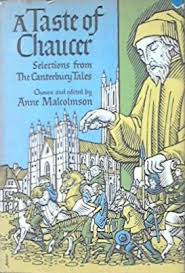
To my mind, there is only one book that gives an adequate flavour of The Canterbury Tales without all the rude, farty bits, and that's a very old book called A Taste of Chaucer by Anne Malcolmson.


Now a rare book!


Up until about three years ago, A Taste of Chaucer was available in paperback from Sonlight, but after the death of the author, it disappeared from the catalogue, and pretty much all affordable options dried up.

However, good news! The book is due to make another appearance, this time in ebook format, thanks to the generosity of Malcolmson's family.

Knights dance at the news!


The publication date is set for 10th of October, 2015. Sign up to the website for updates, and "like" the Facebook page.

In the meantime, the publishers are looking for homeschoolers to draw some pictures as illustrations of the new ebook. Details are here: http://www.atasteofchaucer.blogspot.co.uk/p/the-images-we-need.html

All styles, stages, ages and abilities are encouraged to enter -- the wider variety, the better. The only real limitation is that the pictures must be original and drawn in black and white.

Enter now -- all winners get free copy of the book!


Friday, 24 July 2015

Summer Giveaway!!! Three Copies of Cindy West's new Charlotte Mason workbook!

If you have ever wondered what the Charlotte Mason method is about, or if you are implementing it in the best way or not, then look no further than Cindy West's new ebook called "Charlotte Mason Homeschooling in 18 Easy Step-by-Step Lessons."


New Workbook from Shining Dawn Books


I first encountered this book about a month ago when someone mentioned it on Facebook. I bought a copy because I wanted to see if there were an easy introduction to CM that didn't overwhelm a newbie with information.

The answer was -- YES -- this is an easy introduction to CM that doesn't overwhelm.

More than that, it's a great reminder and tool for veterans like myself to remember the important hallmarks of the CM method, and even gentle helps for re-introducing the bits that often fall by the wayside, like music appreciation or art.

It further inspired me in the planning of the online courses I run under the name of Dreaming Spires Home Learning -- to choose living books, to encourage a relationship with the subject matter, to inspire a desire to go beyond the ordinary.

As per my usual MO, I immediately wrote Cindy herself to tell her how much I enjoyed her book, and offered to buy a copy for giving away. She said, "Take three, and I'll just donate them!"

Wow! What a gal!!!

So, here's your chance -- enter the Rafflecopter giveaway starting the 25th of July for your chance to win a copy of Cindy's new CM workbook. Offer ends 1st of August!


a Rafflecopter giveaway

Saturday, 14 March 2015

Nature Study in Spring

Here in the UK, we haven’t sprung our clocks forward yet, but the signs of spring are definitely upon us.

As the followers of the Charlotte Mason method, nature study is supposed to be a big part of our homeschool curriculum. We’re not always very good at it, but this time of year, it seems that we can’t help but notice the changes all around us.

This week, we’ve been particularly revelling in the annual sightings of frogs in our pond, a frenzy of their little slimy bodies in piles, usually sitting atop a grapefruit-sized lump of spotted clear jelly.

It’s during this mating period that I am strict with what my kids can do with the garden pond, ie, absolutely nothing! Don’t touch! Don’t poke! Don’t ferry buckets of its water to your paddling pool!

Frogs have always been a fascination of mine, ever since I was 4 years old. One of my earliest memories is the day I kissed over thirty toads.

The endangered Houston toad - just look at those kissable lips!!

I lived in Houston, Texas, at the time. Whenever we got one of our summer gully-washers, the toads would come floating out of our downspout drains. This particular time, I collected them all in the paddling pool in the garage. I must have spent half-an-hour in just running around the pool, popping their little bumpy bodies back into their confinement. Each one I picked up, each time I picked it up, I kissed it.

Sadly, none of them became a prince (at least, not to my knowledge), and even worse, this species of amphibian (Bufo houstonensis) is now endangered, limited to only 9 counties in that vast state, and not seen in the Houston area since my childhood era of the 60s. The finger is pointed at habitat alteration, because this species is a burrowing animal and safe burrowing sites in that huge metropolis are rare these days.

My love for frogs and toads persists to this day, many years from those childhood escapades, and many (many, many!) miles from them as well. To me, frogs and toads of any description are still my dearest wild animals to observe, to cultivate, and to protect, and so I can be a little hitler when it comes to who can do what with my pond in early March.

Of course, the return of the frogs in England is only one sign of spring. Others I've noticed are the little nodding heads of pure snowdrops, the bright and upright purple crocuses under the walnut trees, and on one recent walk in Oxford’s University Parks, the starry yellow faces of the dainty little winter aconite. (Not yet time for the daffodils, but their spears are making their way up through the grass)

Winter aconites add floral sunshine to shady spots.

Then there are the birds. Oh, the birds!!! As England’s long winter nights give way to the piercingly early summer days, the birds are starting their dawn chorus at about 5 am right now (later, in June, it will reach its earliest of about 3:30 am). So far, I have seen only our winter dwellers: robins, dunnocks, a variety of tits, blackbirds, and my nemesis, the wood pigeon. It won’t be long, though, when I will hear the tell-tale calls of the chiff-chaff and the cuckoo, both of which make the same sound as their names.

Chiff-Chaff: I'm kind of boring to look at.

Some of the early signs that are still wanting include the buds of hawthorn bushes. These pale, yellowy-green leaves will soon give way to a darker, fan-shaped leaf which hides the nasty little thorns, but every year I see them, I’m reminded of Robert Frost’s beautiful poem about spring: Nothing Gold can Stay.

Nature's first green is gold, 
Her hardest hue to hold. 
Her early leafs a flower; 
But only so an hour. 
Then leaf subsides to leaf. 
So Eden sank to grief, 
So dawn goes down to day. 
Nothing gold can stay.

As with so many of Frost’s poems, this one is as much about life in general as it is about a season, but the hints of spring are so numerous right now that the cold and dark days of England’s winters will soon, happily, be a distant memory.

To capitalise on the current seasonal changes, there’s an initiative at the UK charity, Woodland Trust, to record eight “firsts” for this season: flowering, mating, bud burst, leaf, feeding the young, first cutting of the lawn for the season, and first live individual animal (which I think means those waking from hibernation or returning from winter grounds, like the brimstone butterfly I saw two days ago, and not the fact that, day in and day out, I've seen those darn wood pigeons flapping about in the birch tree).

The Trust provides many resources online such as some nice pdf charts; a set of 6 information packs about ladybirds, frogs, two kinds of butterflies, and two kinds of plants; and updates to remind you what to look out for: today, that’s the song of the song thrush.

The link for getting involved is here: The Woodland Trust.