Showing posts with label homeschooling and the community. Show all posts

Wednesday, 16 August 2017

Planning for 2017 - Step One

I'm cutting it really, really fine. We're less than a month before we're going to start school, and I haven't really made my plans for the year.

Looking for inspiration in the stars

I thought it might be fun - perhaps instructional - for other homeschoolers to watch me fumble through my plan for 2017-2018.

As you may have gathered if you've followed me for any time, I have four children aged between 10 and 17, and I teach them all together using the Charlotte Mason method.

aka Killer, Rocky, Phoenix, and Timmy


There are shades of interpretation for the CM method, and while there are a lot of purists out there, I'm not one of them. To my mind, Charlotte Mason - genius as she was - was still a classroom teacher and planned, implemented, and managed her philosophy via the lens of being a classroom teacher.

I know ... sacrilege, right?

Well, I'm a former classroom teacher, too, and know for a fact that what one does in a classroom is not what one necessarily needs to do in their living room with their own children.

So, I have taken to heart CM's short lessons, living books, narration/copywork/dictation, while devising my own plan of subjects and scope/sequence.

We always study the Bible, memorize Bible verses, use a math curriculum for each child such as Life of Fred or Shillermath, and then have a stack of books for English literature, philosophy, science, biography, spiritual lives, history, economics, and geography. We work through our stack a little each day, reading in 15-20 minute intervals, and by this step-wise approach, we will usually complete many of the books we start out with in September. (If we don't, we just let them carry over till the next year).

Here's a book that took us over 2 years: celebration!


Added to this, we have a weekly co-op in my house. Last year, we studied Texas History and Biology. Tomorrow, I'm going to discuss with my colleague about this year's plan, but it looks like it will be US Government and Chemistry.

My high schoolers have also been attending outsourced online courses for five years now: both have completed four years of English, and now are working their way through Ancient History and Spanish. All these are undertaken with Dreaming Spires Home Learning, my own international tutorial company where I'm in charge of the English.


Online doesn't have to mean isolated

But what will be our book list for our morning time together? And how am I going to implement my new planning approach with simple spiral notebooks?

These are the questions I'm seeking to answer over the next two weeks, and you're invited to join me on my journey.

Even homeschoolers with more than a decade of experience will have their confusions, uncertainties, and conundrums. What we probably also have is an overall vision for our kids, and an underlying routine.

Friday, 3 February 2017

BLAST from the PAST -- Remembering back to those Toddler Days!

I was cleaning out the hard drive on my computer today and came across this article I wrote but never published about getting jobs done around the house while homeschooling young kids.

The memory of those days with four kids under 7 is a hazy one, but reading my advice from then feels surprisingly relevant still today, and I can see a lot of the fruit from some of those routines and diversions.

Hope you'll be blessed by this if you feel unable to release those grasping hands from your "skirts" when all you want to do is clean a toilet or fill the dishwasher.

Trust me: this season will pass!


WHISTLE WHILE YOU WORK: 5 SURE-FIRE WAYS TO KEEP THE KIDS BUSY (WITHOUT RESORTING TO THE TELLY)*

*This should now read: without resorting to electronics

As a home-schooling mum with young children, I’m often asked how I can get any jobs done with kids always around. I won’t lie and say it’s easy (I’m definitely no super-mum), but with my five sure-fire tips, you, too, can keep your house reasonably tidy, get dinner on the table, and even find time to read, sew, iron, or bake some homemade bread!

1. If they can’t beat you, let them join you.


Pre-schoolers are incurable mimics. They are also desperate to be “big”, so when they see you hoovering, they want to help. Instead of evicting them, try involving them. You will probably have to accept that a chore will take twice a long with your little helpers, but there are other benefits, including:

  • enjoying each other’s company; 
  • making them feel useful; 
  • teaching them a skill that one day they can do on their own. 
Cooking continues to be a favorite pastime 

2. Share the load.


On the subject of responsibility, don’t be afraid to assign a simple task to them. Children are a lot more skilful than we often give them credit for. Sorting socks, folding towels, emptying dishwashers, and tidying away toys are all within the abilities of quite young children. Just don’t expect perfection. My boy was a little over a year old when he started helping with the laundry by throwing dirty clothes down the stairs, but lately he has taken to throwing the clean laundry down as well!

No longer "share the load" but DO the load! 

3. Discover audio books.


Audio books are tapes or CDs where actors read stories aloud, usually with sound effects and music as well. Children as young as eighteen months find them entrancing. Ladybird Books offer a whole range of fairy tales with accompanying tapes, such as “Pinocchio”, “Three Billy Goats Gruff”, and “The Gingerbread Man”. Local libraries also stock longer stories like “The Velveteen Rabbit”, and Amazon sell read-along soundtracks to favourite Disney classics like “Monsters Inc.” or “Snow White”. Two words of caution about audio books: first, you may want to preview material, as it may be unsuitable for toddlers; and second, you may prefer CDs to cassette tapes so you don’t have to keep coming back to turn the tape over.


We've moved from audio books to voracious reading 

4. Turn on the sink.


Sometimes, you need five or ten minutes for a concentrated effort, but there’s a danger of wallpaper desecration if you dare turn your back. That’s where the sink can become your ally. Using a sturdy stepping stool, park your child in front of the basin with a toothbrush in one hand and a small beaker in the other, turn on the cold tap to its lowest trickle, and then dash to your desperate duty. It may be the case that you spend thirty seconds wiping up the puddles when you return, but on balance, you will have come out ahead.


There's still something special about water on the skin 


5. Send them to the garden.


I’ve saved my favourite tip for last. I’m a firm believer in giving children as much fresh air and active play as possible, and when they can do that while I get some work done, all the better. Of course, you won’t want to leave your young children unattended, but should your kitchen sink look out over the garden (as mine does), then you will find that you can do quite a lot of chores while keeping one eye on the kids. If it’s your lounge or bedroom window, think about doing the ironing or folding clothes.


My teen has never outgrown a snooze outdoors 


Finally, let me offer a bonus tip for those times when you need utmost concentration, such as balancing your chequebook or paying bills. Find a reliable teenager – as young as 13 would be fine – and pay them a few pounds to play with your children for an hour or so. These are sometimes called “mother’s help” -- because they aren’t actually having to shoulder responsibilities like a babysitter -- but I think they a better name for them would be “mother’s godsend”.


FIVE TERRIFIC TOYS FOR KEEPING THEM OCCUPIED


1. Indoor trampoline. It may prove so popular, you’ll need two!

2. Lego. Choose a size that’s appropriate for the age of your children.

3. Toy kitchen.Mine doubles as a shop, with a much-beloved cash till.

4. Trains.Or any set of things they can unpack, arrange, and re-pack – hopefully, over and over again!

5. Puzzles. More for nursery-aged children. For toddlers, substitute shape boxes.


Sunday, 25 September 2016

The Three Pathways of Homeschooling

This is going to be a long post. I apologise in advance, but I encourage you to read it, and read to the end: it could fundamentally change how you educate your children at home.

You see, every August/September, I have a crisis of direction.
  • Even after doing this for 13 years.
  • Even after becoming a firm believer in the philosophy and fruits of the Charlotte Mason method. 
  • Even after applying all the good parts of public school that I learned as a teacher there, and knowing what to discard and what to bar completely from entering through our doors.

You’ve probably felt this way, too. In August and September, everyone starts shouting what they’re planning to do for the year — singing the praises of this curriculum, or that program, or about exams or credits or dual-enrollment or American style or whatever, and you think:

… maybe … I’m … doing … it … wrong.


Chances are, you are doing it wrong. Almost all of us are. Me included.

Let me explain.

First of all, I think there are basically three pathways to education, particularly home education. You can see from the introduction that I have certain biases, but we’ll probably all agree on the general principles I’m going to run through.

Number One Pathway: the school-at-home way

I call this the “world’s pathway” — that is, following the way that most people’s countries go about this whole education thing, and the fall-back position for most homeschoolers. It’s what we know, right? The bottom line of this pathway is that students are drilled in an effort to achieve pieces of paper. In some cases, they’re not even drilled: they just end up with pieces of paper because they’ve signed up for something and then proceed to teach themselves. Let me explain:

My teen has just signed up for her first “dual-enrollment” course at a local college. It’s an online English class, and it consists of reading some chapters of a book, writing a paper, and emailing it to the teacher. The teacher them writes back “accepted” or “not accepted”. If you’ve ever read T H White’s Once and Future King, this might remind you a lot of the ant colony where things are either “done” or “not done”. This seems the pinnacle of factory education to me, where a teacher runs a course only in name. All the real learning has either been done by the student before, or the student doesn’t get any real learning or … surprise, surprise … Mom does it! However she gets there, her ultimately outcome is simply this: Done.

The problem with the world’s pathway is that the outcome of “done” is what’s important, not the process along the way. Children can cram and vomit out the expected answers, then go on their merry way, none the wiser.

This is true of so many homeschool approaches, too. Don’t kid yourself: if it’s short answer, fill in the blank, multiple choice, the level of learning is minimal, and the aim, at the bottom of it all, is to be “done” or “not done”.

Number Two Pathway: focus on the process of learning

Now we come to those home educators who have opted for the second pathway, that is, learning for learning’s sake. There is no sense of “done” and “not done”, but of “doing”. They have eschewed the hoops and hurdles of someone else’s idea of success, and focus instead on the process of learning. There are different ways of achieving this aim, and some are very rigid while others are very loose; however, they don’t settle for “done” and “not done”, but are pushing the learning outcome to something lasting. This would be more your Classical Conversations, your Charlotte Masons, your Montessoris and other “living” approaches, including (to some extent) your unschoolers. Curricula and texts and activities work on the nurturing of the learner.

Clearly, as a Charlotte Mason advocate, I find this approach preferable to the first. I’ve been in the done/not done environment as a teacher, and I can spot a done/not done curriculum from a mile away, even if it’s dressed up as something else. The second pathway is clearly a higher level of learning for the student. It takes students further, deeper, broader; expands their level of brain development, motivation, retention; and turns them from “done/to done” or input/output machines into organic, holistic creatures made unique and, theoretically, more adaptable to what life throws at them.

I’m constantly trying to encourage newbies to leave the first pathway and branch out to the second one, because the first one usually leaves them feeling burned out or insufficient teachers, leads them to lots of shouting fights with their kids who find it boring and uninspiring, and therefore, prevents the warm, fuzzy feelings one was expecting to have when teaching one’s children at home. 

Almost everyone who has changed from pathway one to pathway two, if they were having problems, is happier after the change, because it suits their vision of what homeschooling would be like when they were thinking about doing it once upon a time.

PATHWAY ONE IS A LIGHT SWITCH


PATHWAY TWO IS LIKE AN AMOEBA


(Pardon my analogies … I’m doing my best!)

However - and grab onto your seats - BOTH PATHWAYS ARE WRONG!


The right pathway is pathway three. If you’re religious, it’s God’s pathway, but even if you aren’t, don’t give up … I’m not going to cram the gospel down your throat. I’m going to tell you something amazing about how to educate your children at home.

Or, maybe I should say “WHY” you educate your children at home.

You see, your educational philosophy — whether religious or secular — has a spiritual or philosophical or at least a moral element to it. I mean, if you’re trying to sit down and read a book with your kids or make them read a book, but they’re fighting instead, and you just say something like, “For goodness’ sake, can’t you just get along like good people do?!!!”

What about, “It’s not nice to hit.”

“Don’t call people names — it’s not nice.”

“Only bullies act like that.”

“Share.”

You see, the fundamental things that homeschoolers do — all of us — is instill our absolute values in our children.

Does that make you shudder? Maybe it should. You know, a Neo-Nazi white supremist family who homeschools will be inculcating their Neo-Nazi white supremist values to their kids. A free-love naturist hippy who homeschools will be passing on their free-love naturist hippy values.

Maybe they’re Muslim extremists, Christian extremists, atheist extremists, socialists, drug-heads, welfare “spongers”, Asian Tiger Moms, or even Republicans, Democrats, Greens, Libertarians, monarchists, anarchists …

Hopefully, you’ve got the point.

Just to be clear. I am absolutely not making the point that the government should “do something” about all these different isms and ists who are homeschooling their children. For one thing, no government could possibly succeed in preventing parents from passing on their values short of removing the children from the family. Even sending children to school for 6 hours a day, 5 days a week isn’t going to stop the family values from creeping into a child’s moral fabric. 

Perhaps naysayers would argue, “Well, at least they’re getting an alternative view to their parents’ weird ideas!” No, they’re getting a whole new set of ideas, few of which are helpful or preferable. More on this in a minute.

Schools, because of the plurality of the student body, can’t espouse any unifying message of morality beyond the most diluted “be good” (ie, shut up and be quiet and don’t make any waves). Clearly, it can’t put forth any religious position of absolute truths out there, or there would be major ructions. It can’t be wholly secular, either, because there are no agreed guiding principles if you have no agreement on “absolute truth”.

All the schools can do is hope that their “be nice” message and “work hard” hopes will filter down to some sort of general order, but we all know how well that’s succeeded. Even if you personally haven’t been struck down by major tragedies like mass shootings, you or someone you know will have been badly hurt by bullying — this might not be a national tragedy, but it’s darn well a personal tragedy for millions of children, all of whom relied on the school to teach a value system.

No. Schools aren’t where the value systems of worth are found.

So, legislate as they might, governments will never replace the moral compass of a child’s home. That means the only place that your child can set his or her moral compass is at your hearth, and that means the chief end of homeschooling — whatever your religious or philosophical beliefs — is a moral one.

If you’re a Christian, this is a clear-cut direction. You use the Bible to study more of who God is, who you are in God, and how that impacts on your unique mission in life. According to R C Sproul in his excellent book called When You Rise Up, this will include equipping your children to teach their own children, who in turn will teach their children, etc.

It is an impactful pathway!

If you’re not religious, then you may like to use the two fundamental principles of natural law as set out by Richard Maybury in his Uncle Eric series of books:
  1. Do all that you say you’ll do
  2. Do not encorach on others or on their property
These two fundamental principles will get you a long way amongst fellow humans in the world.*

So let me re-cap:

PATHWAY ONE - Homeschool in a way that follows input/output methodologies, where study is a means to an end like credit hours, exam grades, degrees, and a good job. This way serves a purpose.
PATHWAY TWO - Homeschool in a way that seeks learning for the sake of learning. Qualifications may happen along the way, but you’re mainly trying to equip your children for skills they’ll need throughout their lives, come what may. You focus on process more than you focus on outcome. This pathway also serves a purpose.
PATHWAY THREE - Homeschool in a way that’s mindful of the moral messages that you teach your children, both by study and by your life in words and deeds. You set the bar of what success actually means, both in terms of academic and personal success. You know a child can always learn from a book, even after having left home, but the moral compass is set when they’re young and at home. Your studies, therefore, are not taken in a vacuum. Even something like Texas History can discuss the moral issues regarding clashes of cultures and needs/wants, and these discussions can help them tease out the hard choices when they’re adults. This pathway not only serves a purpose, but serves a society.

So, if you don’t take PATHWAY THREE, does that make you a bad homeschooler?

I think it’s the wrong question to ask. You signed up to pathway three the moment you started having children, so it’s not a matter of “if” but of “when” you start walking this way.


Parenting is about journeying with your children.
Setting your child’s moral compass is a fundamental purpose of being a parent, and therefore, you should look into using every and all resources for fulfilling that purpose. Of course, moral compasses will differ from family to family. That’s the problem of our having free will because we’re human beings. I mean, clearly it isn’t for us to decide whose free will is allowed to be free, and whose isn’t.** 

Just by focusing on principles, you’ll be teaching your children that there are such things as absolutes, and that’s a eye-opening lesson in today’s relativistic world.

Having a generation of homeschoolers who know that there’s such a thing as right and wrong will be a great influence on future society, and possibly position them to be world changers.

Be careful: you’re not nurturing them so that they can be world changers … instead, you’re nurturing them first and foremost to be moral/kind/godly, and then they CAN be world changers.

SO TAKE COURAGE, MOMS AND DADS — WHEN YOU THINK YOU’RE JUST STUCK AT HOME AND NOT MAKING A DIFFERENCE, YOU COULD MAKING A WORLD OF DIFFERENCE!


*Of course, religious people would urge you to think beyond the tangible and limited world that we see, and consider the spiritual world beyond — but that’s another topic to save for another day.

** It’s easy to get self-righteous and judgmental here. Remember to take the plank out of your own eye before you point out the splinter in your neighbour’s.


Wednesday, 24 September 2014

The Socialization Myth

I'm now a veteran of homeschooling of more than 12 years. I once taught in secondary schools in England, but decided I was in a ludicrous position of being paid to teach other's children, and paying others to teach my own -- so, I decided to cut out the middleman and start to teach my kids.

Equally, I became more and more aware that eight hours of school a day merely results in four hours of homework at night -- at least, it did in the private girls' school where I was a teacher. What an empty life for a child of 11 -- just school, school, and then when they got home, more school.

Again, I saw the value in cutting out the middle bit -- that is, the eight hours at school -- and just doing the homework bit, leaving my children an extra eight hours to bond together, to connect with me, to meet up with friends, and sometimes, to be quite alone and do nothing, if that's what they wanted.

BUT, people new to homeschooling, or thinking about homeschooling, or criticizing homeschooling, always want to bring up the "socialization" card, as though schools are the only place -- or, what's more, the BEST place -- for children to learn to get along with people.

Is this the ideal way to make relationships???

In fact, I would argue that they are actually the WORST places to learn to get along with people. Why?

  • For one thing, if you fall out with a friend at school, you can just get another one. Homeschoolers have to cherish their friendships, and work through issues. They may not have hundreds to choose from, but they have a few that they bond with over many years of a quality relationship.
  • For another, you are stuck in a room of 25 or 30 or 35 or more kids exactly your own age, give or take a few months. Real life doesn't work like that. My best friends range in age from 30 to 50. My kids' best fiends are several years apart from them in both directions, too. In fact, my gregarious 9-year-old sometimes does the "rounds" with the elderly ladies in our neighbourhood.  Sure, she's after extra cookies or sweets or a chance to pet the dogs, but she is connecting and relating to the elderly ladies at the same time. Just two weeks ago, we were at the Bunyan Museum in Bedford, and she begged me to use her pocket money for buying a souvenir thimble for one of her lady friends, because she has a relationship with that lady and knows she enjoys collecting them.
  • A third point, and this is my own observation, is that schools tend to only tear families apart -- younger siblings daren't play with older ones, and everyone has a passel of their own friends who make no room for taggers-along. Siblings rarely have anything in common with each other, and are lucky to come together in a sort of tag-team moment in the kitchen over cookies and milk before running off to this and that and the other activity of an evening. We still have the afternoon activities, but the rest of the day, the kids are learning, playing, and living together, and gathering vital information and putting into practice about how to get along.
  • Finally, so much research out there points to how socially adept homeschooled kids are, and these studies cite the fact that they interact so much with adults in their day-to-day life, instead of school-based children who mainly get peer behaviour as their role models.  In the Bible, this would equate to Proverbs 13:20 -- "Walk with the wise, and you will become wise: for a companion of fools suffers harm." I'd rather my kids grew in wisdom, frankly.
Quality over quantity when it comes to homeschooling relationships.
I think most people start with the assumption that school-based relationships are right, and thus, homeschooled ones -- being different -- are wrong. What they need to do is, first, take a look at their own life out in the real world and genuinely assess whether their social life looks anything like the high-pressured, ultra-distracting, regimented, and segregated system that's found in most schools.

Doesn't this picture below represent the way that adults socialize???

Business lunches, book clubs, weekend warriors --
the way adults work and play sure look a lot like a homeschooler's day!


Friday, 25 April 2014

Hosting a Foreign Bear for Easter

A bundle arrived in the post from New Zealand, the contents of which included a little teddy bear, a selection of souvenirs from the Far East, Hawaii, and New Zealand, and a letter which requested we show him a good time in our country before posting him back to his homeland of San Diego, California.

Isaac arrives in Britain:
Notice the red phone box in the background,
and all the cars driving on "the wrong side".


Isaac Bear is part of a project for an elementary school in the US, and we were very excited to take part in it. He joined us for everything: our homeschooling co-op with the Aberkats, swimming training, meals out, cinema trips -- it was a great time for him to be with us, as it was our Easter holidays.

Aberkats Co-op


We especially enjoyed bringing him along to the various Easter celebrations: Good Friday walk around Banbury, doing the stations of the cross, and an Easter sunrise service in the fields of the Cotswolds, not to mention an all-you-can-eat Thai buffet with our friends.

Stations of the Cross

Sorry, Isaac -- a sunrise service
in England doesn't always mean
there will be sun!


The piece de resistance was taking him to the Castle Inn at Edgehill on Easter night, looking out over the hills where Charles I had begun the English Civil War in October of1642. Too bad it was really foggy!

Isaac's such a ham, he forgot to look at the view!


As per instructions, we sent him packing on the 22nd, hoping he'll make it back to his headquarters by the May 1st deadline.

Bon voyage, Isaac.
(Banbury Cross in the background)

For me, the best part of the project was that we received our bear from a homeschooling family in New Zealand, some of whom are currently my students for the Dreaming Spires literature courses I run. It's making global connections like these that are the future of homeschooling, so I liked showing how it works in practice to my kids.

Sunday, 13 April 2014

Tapping into the Council

Bikeability Begins
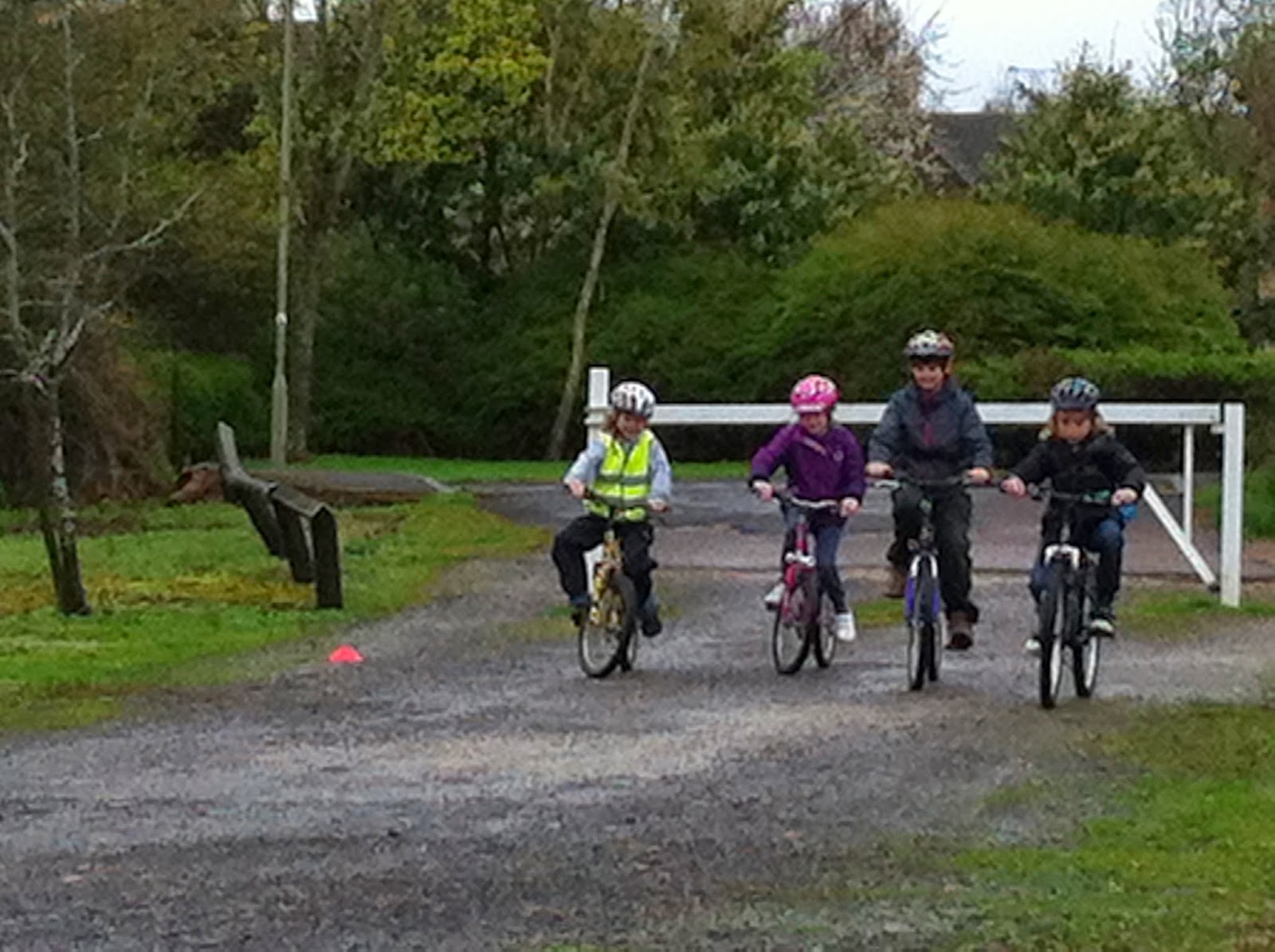
It isn't often that we ask the local council for anything, other than to be left alone a la rights for homeschooling families. This last week, however, we worked with some very nice people at the county who helped us to provide cycling proficiency classes for twelve local homeschoolers.

The Tutor with her Watchful Eye

Since most kids in England are put through cycling proficiency at their schools, it's sometimes hard to pin down the same opportunity for the home-ed community. When my eldest wanted to do it, she had to carpool with a neighbour to Banbury, a town about 16 miles away. This time, we made arrangements for it to happen right on our doorstep.

Raring to go!

Monday was a bleary, dreary morning -- the first day of schools' Easter holiday period, but we were up and out the door for a (generous) 10:30 am start, meeting at the car park to the local Bowls club. Bike checks. Helmet checks.  How's them brakes? A bit of obstacle course, and then over the next few days, the kids were even sent to tackle THE BIG HILL.

Navigating real roads.

By Friday, they were all duly passed for their right turns, their left turns, their stops and signals, their road sense and judgment.  Yes, even Rocky passed on all these skills, and now I have only one more child to make safe on the roads before my job can be considered done.

Happy Trails.

That's not for another few years yet.

Thanks to all the local homeschooling families who took part, and to another home-ed mum who took the lead on the afternoon group of 6. The process was all very painless in the end, and I'm happier to let my kids pop to the shops on their bikes, knowing that they will be visible and communicative to the other vehicles around them.

(Now if we could just get the same support for exam centres and fees for our secondary students, we'd be quids in!)

Saturday, 4 May 2013

Parents at Home are Working, too! Sign the petition (link)

A mum who is "working hard" and "getting on", the family way!
Give us our due, Mr Cameron -- respect!!!!

I'm afraid I'm at my wit's end on this one. For years, I've been trying to get my MP -- who is the Prime Minister, David Cameron -- to understand that some people believe it's best to stay home and raise our children rather than going out to work and letting others raise them for us.

This is not a diatribe against those families who choose that option.

It's a diatribe against a Government that once claimed to stand for family values, and at every turn, is aiming to reduce families to a simple numbers game in terms of tax revenue.

Please hear me, Mr Dave -- people "work hard" and "want to get on" in a myriad ways that your narrow definition doesn't even begin to touch.

I work very, very hard, and I want to "get on" in terms of influencing my children to love their studies, to be independent in their education, to be good citizens, to love people regardless age, social status, colour, creed, and to ensure that they're very balanced individuals on an emotional level.

All these results are proven traits that are often found in home educated kids, and for that reason, I have given up my opportunity to strive to be a Headmistress of a school of other people's children, and mentor my children instead.

Again, I say, this isn't pointing a finger at anyone who does go out to work. It's just that the system needs to redress the balance so that anyone who stays at home isn't being penalized in the tax system for doing so.

As it stands right now, a family with one wage earner is severely penalized in terms of tax and available credits when compared to a two-earner family of comparable gross income.

I can't see it as anything but a narrow view of what it means to "work hard" and "get on", as though forcing us out to work is for everyone's good (for one thing, my children would cost more to the taxpayer if I sent them to school than I could ever pay in taxes!).


"I coulda been a contender!"
We all make tough choices every day, but the Government needs to be fair when those choices are valid!
Or, maybe, the Tories don't think  our choice is valid???


So, I'm not asking you to agree that staying at home is better than going out to work. I'm simply asking you to agree that the Government should consider those who stay at home as making a valid career choice, and acknowledging that today's system is penalizing single-earning families when compared to double-earning families on comparable wages.

It's just a matter of giving "Fair Play for stay at home mums and dads".

Tthe more support we can get behind the campaign, the better chance we have of succeeding. You can read more and sign the petition here:

http://you.38degrees.org.uk/petitions/fair-play-for-stay-at-home-mums-and-dad-s

Thanks!

Saturday, 18 February 2012

Recent Blog Entry Teases out UK Home-Ed Law and Misunderstandings in the Media

Home Education in England has come under the Government's scrutiny in the last couple of years, mainly because of some high profile cases of child abuse which the media still tries to link to home education.

The facts of this are misremembered, skewed, and often entirely wrong.  Our most notable case was of a child who was withdrawn from school under Home Education laws, but who had been known by the social services and whose siblings were flagged as being malnourished at school, and yet the authorities didn't act in time to save her life.

Home Education was never the culprit, though the newspapers often like to say that it was a contributing factor.

A home-educating dad has taken a stand about this and written a very thorough, reasoned response to an article about this published in the Times Education Supplement last autumn.  Pour yourself a cup of coffee and have a look at it.

http://northshropshe.wordpress.com/2012/02/15/khyra-ishaq-abused-twice/

Tuesday, 6 December 2011

The Joy of Posada

Our church runs a scheme during Advent called the Posada, which is a re-enactment of Mary and Joseph looking for lodgings on Christmas Eve.  The festival originated in Latin American countries and traditionally starts on the 16th of December, but we start ours on Advent Sunday.

Essentially, it's a rota of people who agree to keep the Mary, Joseph, and donkey figures from our church's nativity set. Each evening, the people with the holy family meet with the next people on the rota, and effect a changeover. This goes on until Christmas Eve, when the figures are processed to the front of the church and placed in the nativity scene.

The changeover is supposed to be a time of prayer and celebration together, though these may sometimes have to happen on the fly with a quick "God bless"; other times, there's a whole afternoon of tea and mince pies, or a meal, or a few minutes of quiet together.  It just depends on what people want to do, and what they have time for.

"Busy Timmy" unveils the scroll;
Phoenix in the conservatory (background) lights the Advent candle

The best thing about Posada is meeting up with people that you rarely have a chance to spend time with.  For example, we received the holy family from a friend of mine who's a single mum and whose schedule is so opposite to mine that we've never managed to share that glass of wine we always talk about.

Last night, we had her and her daughters over for the Posada hand-over, and they stayed for dinner.  It was fantastic!

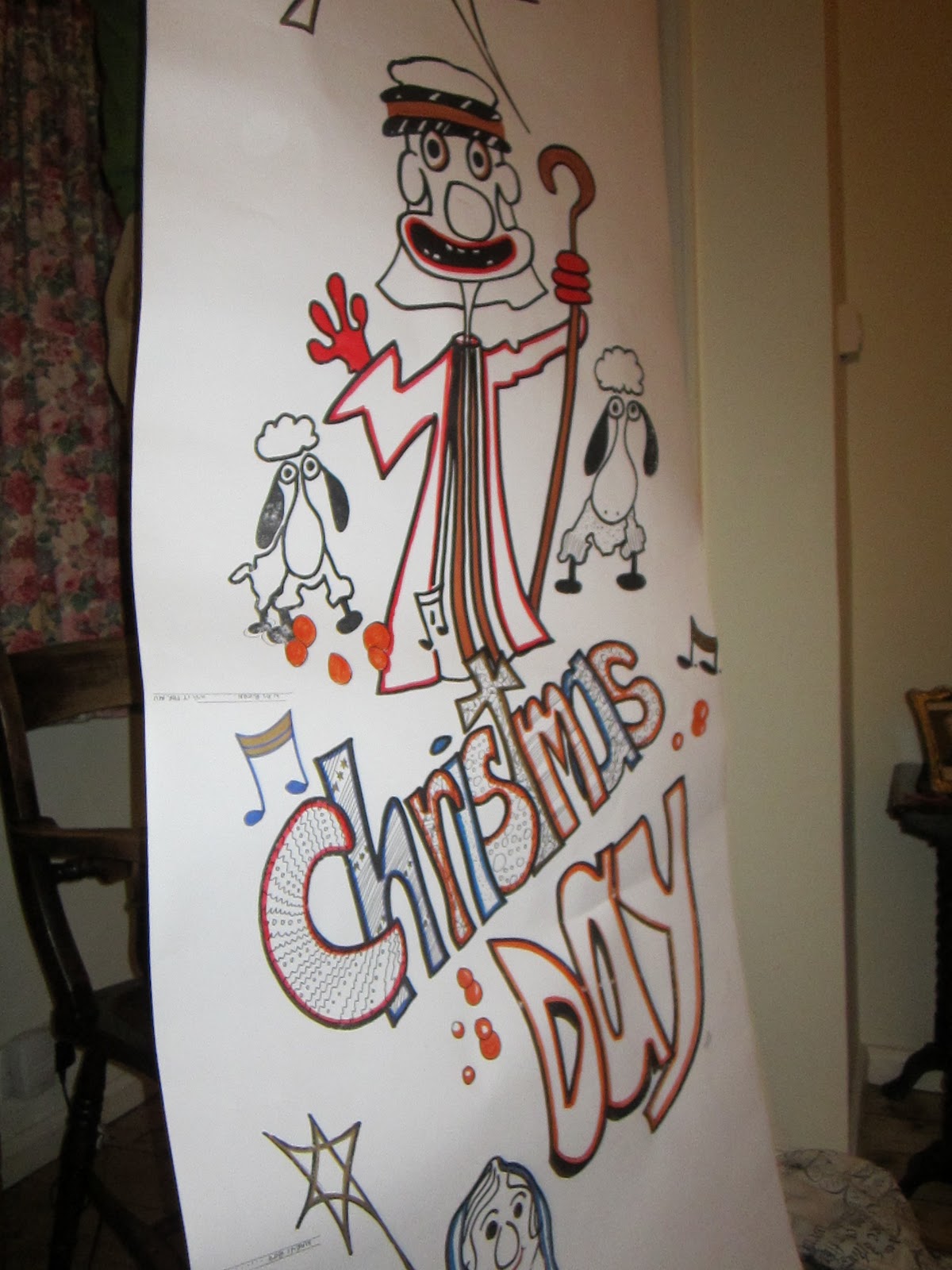
Then this afternoon, we took the Posada figures to the home of a retired Vicar and his wife.  They had the children light their Advent candle, and then played "Mary's Boy Child" while unrolling a huge scroll that someone had made on wallpaper that depicted the song in cartoon characters.

"Man will live forever more because of Christmas Day"
Busy Timmy was absolutely fascinated, and though my children are pretty well-versed in their Bible stories, he has come away with that scroll burned into his memory.

So thanks to our new friends and our old friends, and thanks to the whole idea of the Posada.